
Oruro Carnival Mythology: A Deep Dive into Cultural Significance
The Oruro Carnival is more than just a party; it’s a vibrant tapestry woven from centuries of history, faith, and the enduring power of myth. Recognized by UNESCO as a Masterpiece of the Oral and Intangible Heritage of Humanity, this Bolivian cultural festival is a spectacle unlike any other, drawing visitors from across the globe to the high-altitude city of Oruro. At its heart lies a profound connection to Oruro Carnival mythology, a rich blend of pre-Hispanic Andean beliefs and colonial Catholic traditions that gives the celebration its unique spiritual and artistic depth.
Introduction to the Oruro Carnival
Nestled high in the Bolivian Andes, Oruro town transforms annually into a pulsating center of color, sound, and fervent devotion for its world-renowned carnival. This isn’t just one of the largest festivals in South America; it’s a living museum of cultural storytelling, a grand procession that showcases the very soul of Bolivian traditions. For ten days leading up to Ash Wednesday, the streets of Oruro burst with carnival celebrations, culminating in a spectacular main procession, the Entrada, where thousands of dancers and musicians perform for over twenty hours straight. This incredible display is a testament to the enduring spirit of the Bolivian people and their deep reverence for their cultural heritage. Every step, every note, every intricate costume tells a story, making the Oruro Carnival an unparalleled experience for anyone interested in cultural festivals and the rich tapestry of human expression.
Historical Background of Oruro Carnival
The origins of the Oruro Carnival are deeply rooted in Bolivia’s complex past, reflecting a fascinating syncretism born from the encounter between indigenous Andean culture and Spanish colonial influences. Before the arrival of the Spanish, the Uru people, who inhabited the region, celebrated Anata or Phujllay, ancient rituals dedicated to Pachamama (Mother Earth) and the Tio Supay (Lord of the Underworld or mines). These pre-Hispanic ceremonies involved offerings and dances to ensure bountiful harvests and protection for miners, whose livelihoods depended on the mountain’s generosity.
When the Spanish conquistadors arrived in the 17th century, they brought with them Catholicism, attempting to suppress native religious practices. However, the indigenous people cleverly adapted, integrating their ancestral beliefs into the new Christian framework. The veneration of Pachamama subtly merged with devotion to the Virgin Mary, and the Tio Supay found a new guise in the Christian devil. This blending of spiritualities laid the groundwork for the Oruro Carnival history, evolving from clandestine rituals into the elaborate public celebration we see today. Over centuries, these traditions were formalized, incorporating elements like the Diablada (Dance of the Devils) and other traditional dances, each with its own narrative and significance, solidifying the carnival’s place as a cornerstone of Bolivian folklore and a symbol of national identity. The carnival’s evolution is a powerful example of cultural resilience, where ancient customs persist and thrive within a modern context, ensuring the historical significance of these festivals and rituals remains vibrant.
Mythological Elements in Oruro Carnival
The true magic of the Oruro Carnival lies in its profound connection to Oruro Carnival mythology. Every character, every dance, and every piece of music is steeped in a narrative that bridges the spiritual and the earthly. The carnival is a dramatic reenactment of epic mythological stories, where good battles evil, and ancient Andean deities mingle with Catholic saints, creating a unique spiritual landscape. This section explores the core myths that animate the carnival, offering a window into the Bolivian psyche and the enduring power of its cultural myths.
The Legend of the Virgen del Socavón
Central to the Oruro Carnival mythology is the revered figure of the Virgen del Socavón (Virgin of the Mineshaft). Her legend is a poignant tale that embodies the syncretic nature of the festival. According to popular belief, in the late 18th century, a notorious bandit named Anselmo Bellarmino, also known as “Chiru Chiru,” roamed the mining town of Oruro. Though a thief, Chiru Chiru was said to have a compassionate heart, often sharing his spoils with the poor. He was also a devout follower of a beautiful image of the Virgin Mary, which he kept hidden in his humble dwelling.
One fateful night, Chiru Chiru was fatally wounded in a brawl. As he lay dying in a cave, the Virgin Mary appeared to him, offering comfort and forgiveness. Miraculously, her image was later discovered in a mineshaft (socavón), leading to her veneration as the patron saint of miners. This legend solidified the Virgen del Socavón’s importance, transforming her into a protector against the perils of the mines and the guardian of the carnival. The main procession, the Entrada, culminates at her sanctuary, where dancers offer their performances as a tribute of faith and gratitude, underscoring the spiritual significance of the entire event. Her presence is a powerful reminder of the intertwining of faith, hardship, and hope that defines the lives of many Bolivians.
Andean Mythology Influences
Beyond the Christian facade, the Oruro Carnival is deeply imbued with the influences of ancient Andean mythology. These pre-Hispanic beliefs provide the conceptual framework for many of the carnival’s themes and characters, demonstrating how indigenous spiritual systems continue to shape modern Bolivian traditions.
The most prominent Andean deity represented is Pachamama, the Mother Earth, who is revered as the source of life, fertility, and abundance. While not explicitly depicted as a single character, her presence is felt throughout the carnival through offerings, rituals, and the general celebration of life and harvest. The carnival, in many ways, is a grand offering to Pachamama, seeking her blessings for the coming year.
Equally significant, and often more overtly represented, is the Tio Supay, or simply El Tio (The Uncle). In Andean mythology, El Tio is the Lord of the Underworld and the guardian of the mines. He is a complex figure, both feared and respected, embodying the dangers and riches found beneath the earth. Miners traditionally make offerings to El Tio to appease him and ensure their safety and successful extraction of minerals. During the Oruro Carnival, El Tio is personified by the figure of the devil, particularly in the iconic Diablada dance. This representation is a prime example of syncretism: the indigenous Tio merged with the Christian devil, allowing ancient veneration to continue under the guise of a Catholic performance. The elaborate masks and costumes of the devils reflect his fearsome yet powerful nature.
Other Andean deities and mythological creatures, though perhaps less central than El Tio, also make appearances. Figures like the Condor, Puma, and Vicuña – sacred animals in Andean culture – are often incorporated into costumes and dances, symbolizing various aspects of the natural world and spiritual power. The Llama, crucial for survival in the Andes, is also celebrated. These elements ensure that the carnival remains a vibrant expression of Andean culture, connecting participants and spectators to an ancestral worldview where the mountains, the earth, and its creatures hold deep spiritual meaning. The interplay between these ancient beliefs and the Christian narrative creates a rich tapestry of cultural myths that defines the Oruro Carnival mythology.
Cultural Significance of the Carnival
The Oruro Carnival transcends its role as a mere spectacle; it is a profound expression of Bolivian cultural identity and a vital mechanism for preserving cultural heritage. For the people of Bolivia, particularly the Oruro community, the carnival is a moment of profound collective affirmation, a celebration of their unique history, beliefs, and artistic traditions. It serves as a powerful reminder of their resilience in adapting and maintaining indigenous customs under colonial influence.
This annual event is a cornerstone of community celebrations, fostering a strong sense of belonging and shared purpose. Families often participate across generations, passing down the intricate skills of costume making, the complex steps of traditional dances, and the mythological stories that give meaning to each performance. This intergenerational transmission ensures the continuity of Oruro traditions and keeps Bolivian folklore alive. Beyond the local community, the carnival projects Bolivia’s rich cultural tapestry onto the global stage, attracting international attention and contributing significantly to Bolivia tourism. It highlights the country’s diverse ethnic groups and their contributions to a shared national identity. The spiritual significance of the carnival, with its blend of reverence for the Virgen del Socavón and ancient Andean deities, reinforces a unique spiritual landscape that underpins the everyday lives of many Bolivians. Through its festive celebrations and elaborate rituals, the Oruro Carnival becomes a dynamic form of cultural storytelling, educating both participants and observers about the enduring power of cultural myths and the vibrant spirit of Andean culture.
Key Traditions and Practices
The Oruro Carnival is a meticulously organized series of festivals and rituals, each playing a crucial role in the overall narrative and experience. The entire event is characterized by its elaborate preparations, from the months-long rehearsals of dance troupes to the painstaking creation of the magnificent carnival costumes. These traditions and practices are not merely decorative; they are symbolic acts that reinforce the mythological narratives and cultural identity of the participants.
Costumes and Masks: Symbols of Identity
The visual spectacle of the Oruro Carnival is largely defined by its breathtaking costumes and masks, which are far more than mere adornments. They are powerful symbols of identity, history, and mythology, each piece meticulously crafted to embody a specific character or cultural motif. The sheer variety is astounding, reflecting the diverse groups and mythological stories represented.
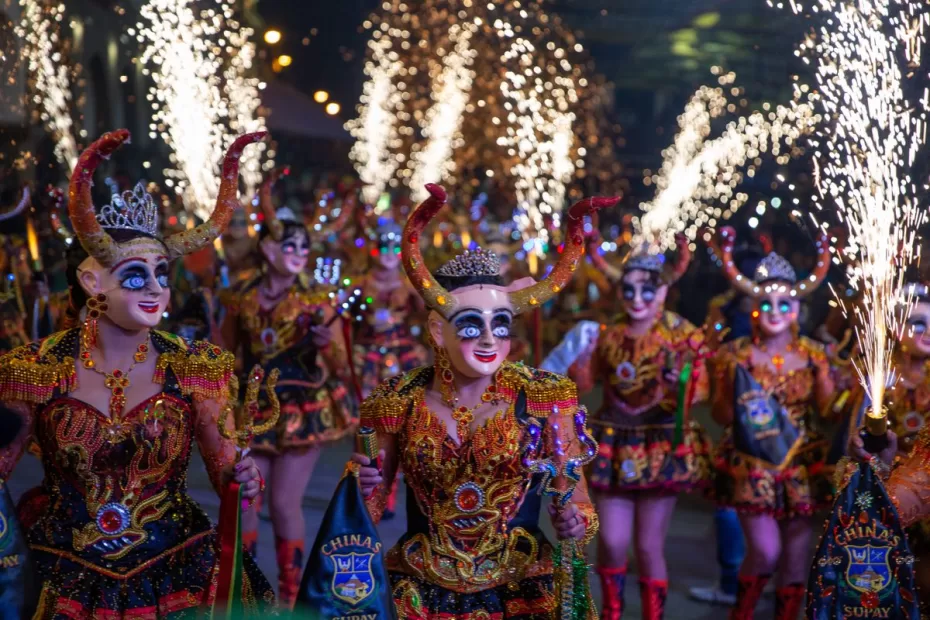
The most iconic costumes belong to the Diablada dancers, who portray the devils. Their masks are elaborate works of art, featuring grotesque faces with bulging eyes, sharp horns, and often serpents, to represent the Tio Supay and other demonic figures. These masks are often adorned with intricate details, mirrors, and even precious stones, making them incredibly striking. The full devil costume includes a cape embroidered with religious and mythological symbols, a chest piece, and high boots, all designed to convey power and fear.
Other prominent dances feature equally significant attire. The Morenada dancers wear heavy, richly adorned costumes that symbolize the African slaves brought to the mines, with their distinctive large-brimmed hats and masks that depict the suffering and exhaustion of the miners. The Caporales costumes are vibrant and military-inspired, with bells on the boots, reflecting a more contemporary and energetic expression of cultural identity. The Kullawada dancers, representing weavers, wear elegant and colorful outfits that highlight the intricate textile traditions of the Andes.
Each costume and mask tells a story, often reflecting historical narratives, social commentary, or the specific characteristics of the mythological figures they represent. The creation of these costumes is a deeply communal and artistic endeavor, often involving families and artisans who dedicate months to their perfection. This tradition ensures that the visual language of the carnival remains a powerful form of cultural storytelling, preserving the essence of Bolivian traditions and the spirit of the Oruro Carnival mythology.
Dance Performances: A Narrative Art
At the core of the Oruro Carnival are the traditional dances, which are not merely performances but living narratives that embody the carnival’s rich mythology and historical significance. Each dance troupe, or fraternidad, dedicates itself to mastering specific choreographies that convey a particular story, emotion, or historical event, making dance and mythology inseparable in this festival.
The undisputed queen of the Oruro Carnival is the Diablada, or “Dance of the Devils.” This powerful performance narrates the eternal struggle between good and evil, with its central figures being the Archangel Michael leading a legion of devils, often accompanied by the China Supay (female devil) and a bear (representing the primitive forces). The devils, with their fearsome masks and energetic steps, are performing a pilgrimage to the Virgen del Socavón, ultimately subdued by the Archangel. This dance is a direct representation of the Tio Supay and his eventual submission to the Virgin, a cornerstone of Oruro Carnival mythology.
Another significant dance is the Morenada, which literally means “dance of the black people.” This slow, majestic dance originated from the experiences of African slaves brought to work in the silver mines. The heavy, rhythmic steps are said to mimic the arduous walk of chained slaves, while the masks often depict their suffering. The Morenada also features characters like the Rey Moreno (Moreno King) and the Achachis (old men), offering a glimpse into a specific historical and cultural myth.
The Caporales is a more modern, energetic dance that emerged in the 1960s, inspired by the foremen (caporales) who oversaw the African slaves. It’s characterized by its vibrant costumes, elaborate jumps, and intricate footwork, celebrating strength and exuberance. While not as ancient in its mythological roots, it still represents a part of Bolivia’s social history and cultural identity.
Other notable dances include the Kullawada, representing the skilled weavers of the Altiplano; the Tobas, depicting indigenous Amazonian warriors; and the Llamerada, celebrating the llama herders and their connection to Andean culture. Each of these traditional dances contributes to the grand narrative of the carnival, using movement, music, and costume to tell mythological stories, preserve Bolivian folklore, and celebrate the diverse cultural heritage of the nation. The continuous rhythm of traditional music accompanies these performances, creating an immersive experience of festive celebrations and profound cultural expression.
Ongoing Challenges and Modern Adaptations
While the Oruro Carnival remains a beacon of cultural heritage and a vibrant expression of Oruro Carnival mythology, it is not immune to the challenges of the modern world. One significant concern is the increasing commercialization of the event. As its global fame grows, there’s pressure to cater to tourist demands, which sometimes risks diluting the authenticity and spiritual significance that are so central to its core. The proliferation of souvenir stalls, branded events, and corporate sponsorships, while providing economic benefits, requires careful management to ensure the carnival’s traditional essence is not overshadowed.
Another challenge lies in maintaining the integrity of the traditional dances and costumes. As new generations take part, there’s a delicate balance between innovation and preserving the historical accuracy and symbolic meaning of each element. Some worry about the loss of specific dance steps or the simplification of elaborate carnival costumes. Environmental impact is also a growing concern, with the sheer volume of participants and spectators generating waste that needs sustainable management.
Despite these hurdles, the Oruro Carnival demonstrates remarkable adaptability. Modern technology, such as live streaming and social media, has become a tool for cultural storytelling, allowing the carnival’s reach to extend far beyond Oruro town, engaging a global audience and fostering greater appreciation for Bolivian traditions. Organizers and fraternities are increasingly proactive in educating participants and tourists about the Oruro Carnival mythology and its cultural significance, emphasizing respect for its spiritual roots. Efforts are also made to involve youth in traditional dance schools, ensuring that the knowledge and passion for these festivals and rituals are passed down. This ongoing commitment to cultural preservation, while embracing necessary adaptations, ensures that the Oruro Carnival continues to thrive as a dynamic and evolving celebration of Bolivian folklore and cultural identity.
Conclusion: The Future of Oruro Carnival Mythology
The Oruro Carnival stands as a magnificent testament to the enduring power of Oruro Carnival mythology, a vibrant celebration where ancient Andean beliefs and colonial Catholic narratives intertwine to create a spectacle of unparalleled cultural and spiritual depth. From the legendary tale of the Virgen del Socavón to the fearsome yet revered Tio Supay, and the myriad of mythological stories woven into each traditional dance, the carnival offers a profound window into the Bolivian soul. It is a living, breathing museum of cultural heritage, constantly evolving yet steadfast in its commitment to its roots.
As the world becomes increasingly globalized, the Oruro Carnival faces the ongoing task of balancing tradition with modernity, authenticity with accessibility. Yet, its resilience, its capacity for adaptation, and the unwavering devotion of its participants suggest a bright future. The continued passion for cultural storytelling, the meticulous preservation of carnival traditions, and the sheer joy of community celebrations ensure that the Oruro Carnival will remain a vital component of Bolivia’s identity and a major draw for Bolivia tourism. The mythological stories, once whispered in the mines or danced in clandestine rituals, are now performed on a grand stage, captivating millions and ensuring that the rich tapestry of Oruro Carnival mythology continues to inspire, educate, and enchant for generations to come. It is a powerful reminder that in a rapidly changing world, the deepest truths and most vibrant expressions of humanity often lie within the oldest and most cherished cultural myths.
SMJILI Casino, man. It’s alright. Game selection is pretty wide, keeps things interesting. Could use some better bonuses, but overall, not bad for a casual punt. Here’s the link: smjilicasino
Alright, checking out dailyjiliapp. Heard some good things, hoping it lives up to the hype! Fingers crossed for some wins. Get yours now at dailyjiliapp
Whinexh, saw you mentioned online. Looks like a fun place to explore. If you have a welcome bonus, that would be even better. Check it out and maybe you will discover something interesting. whinexh
Hey, Xsmega, seems like you are my lucky star for predicting numbers. Always providing insightful information and well-researched predictions. Keep up the good work, Xsmega! xsmega