
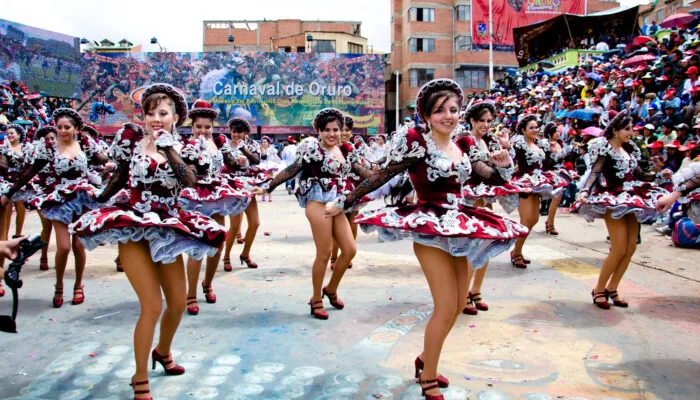
Social Inclusion at Oruro Carnival: A Cultural Exploration
The Oruro Carnival, a vibrant spectacle recognized by UNESCO as a Masterpiece of the Oral and Intangible Heritage of Humanity, is far more than just a pre-Lenten celebration in Bolivia. It is a profound expression of cultural heritage, a tapestry woven from centuries of tradition, spirituality, and community engagement. At its heart lies a powerful narrative of social inclusion, where diverse voices and traditions, particularly those of marginalized groups, find a grand stage for expression and recognition. This cultural exploration delves into how the Oruro Carnival embodies and promotes social diversity, reflecting the dynamic spirit of Bolivian traditions and serving as a beacon of inclusive events.
Overview of Oruro Carnival
Nestled high in the Bolivian Andes, the city of Oruro becomes the epicentre of an extraordinary annual phenomenon: the Oruro Carnival. This monumental cultural festival, celebrated over several days leading up to Ash Wednesday, is renowned worldwide for its elaborate costumes, mesmerizing dances, and deep spiritual significance. Originating from ancient indigenous rituals dedicated to Pachamama (Mother Earth) and the Andean deities, it has seamlessly blended with Catholic traditions introduced during the colonial era, creating a unique syncretic celebration.
The carnival’s central event is the grand peregrination, a solemn yet joyous procession to the Sanctuary of the Virgen del Socavón (Virgin of the Mineshaft). Thousands of dancers and musicians, representing various fraternities, make this pilgrimage, offering their devotion and artistry. The sheer scale and intricate detail of the performances are astounding, drawing participants and spectators from across Bolivia and the globe. Beyond its aesthetic appeal, the Oruro Carnival holds immense cultural identity, serving as a vital platform for the preservation and re-affirmation of indigenous cultures and traditions, making it a cornerstone of Oruro culture. It’s a living testament to the resilience and vibrancy of Bolivian traditions, a celebration of diversity that transcends mere entertainment.
Historical Background of Oruro Carnival
To truly grasp the essence of social inclusion Oruro Carnival, one must journey back through its rich and complex history. The carnival’s roots are deeply embedded in pre-Columbian Andean cosmology, particularly in rituals honoring Pachamama, the god Supay (devil figure), and other ancestral spirits. These early indigenous cultures celebrated agricultural cycles, fertility, and the bounty of the earth through dances and ceremonies that predate European arrival.
With the Spanish conquest and the subsequent evangelization efforts, these indigenous practices did not disappear but rather transformed. The colonizers, finding it difficult to suppress deeply ingrained local customs, often superimposed Catholic saints and narratives onto existing indigenous deities and festivals. This process of syncretism is a defining characteristic of Oruro Carnival history. For example, the ancient figure of Supay became associated with the Christian devil, and the veneration of Pachamama merged with the devotion to the Virgin Mary, specifically the Virgen del Socavón, who became the patron saint of miners.
Miners, often exploited and marginalized, found solace and a voice in these emerging carnival traditions. Their arduous work in the silver mines of Oruro, often under brutal conditions, fueled a spiritual connection to the underworld and the protective powers of the Virgin. The carnival thus evolved from a series of disparate indigenous and colonial practices into a unified, albeit complex, cultural festival that allowed for both spiritual expression and a subtle form of resistance against colonial oppression. Over centuries, various social groups, including mestizos and criollos, began to participate, each adding their own layer to the carnival’s evolving narrative. This historical context reveals how the carnival has always been a space where different worlds converged, sometimes uneasily, but always leading to a richer, more diverse cultural expression. The carnival heritage is therefore a story of adaptation, resilience, and the enduring spirit of community engagement.
Cultural Significance and Social Inclusion
The Oruro Carnival is much more than a lively celebration; it is a profound expression of cultural identity and a powerful vehicle for social justice. Its elaborate performances and deep spiritual undertones create a unique space where the narratives of various groups, particularly indigenous communities and historically marginalized voices, are not only acknowledged but celebrated. The carnival significance lies in its ability to bring together disparate elements of Bolivian society, fostering a sense of collective identity while honoring individual cultural expressions. It serves as a vital arena for social inclusion Oruro Carnival, demonstrating how traditional festivals can actively promote social diversity.
Through the carnival, marginalized communities reclaim their history, language, and spiritual beliefs, transforming what might have once been suppressed into a public spectacle of pride and affirmation. The vibrant display of carnival costumes, music, and dance is a testament to the resilience of these cultures. It’s a moment when the often-overlooked contributions of these groups are brought to the forefront, challenging existing social hierarchies and promoting a broader understanding of cultural heritage. The inclusive events within the carnival facilitate genuine community engagement, allowing participants to connect with their roots and share their traditions with a global audience. This dynamic interplay makes the Oruro Carnival a living example of how cultural festivals can be powerful instruments for social change and recognition.
Indigenous Participation in the Carnival
Indigenous communities are the very heart and soul of the Oruro Carnival. Their participation is not merely an addition; it is fundamental to the carnival’s authenticity and spiritual depth. The rich tapestry of indigenous cultures, particularly the Aymara and Quechua peoples, is woven into every aspect of the celebration, from the symbolic dances to the intricate music and profound spiritual practices.
Many of the most iconic carnival dances, such as the Diablada (Dance of the Devils), the Morenada, and the Kullawada, have origins deeply rooted in indigenous cosmologies and historical experiences. The Diablada, for instance, while outwardly portraying a battle between good and evil through Catholic lenses, also embodies pre-Hispanic beliefs concerning the Supay, or devil figure, who was seen as a protector of the mines and the underworld. Indigenous miners, who formed the backbone of Oruro’s economy, infused this dance with their own struggles and spirituality, transforming it into a powerful expression of their cultural identity and resilience.
The Anata Andina, a crucial pre-carnival event, is entirely dedicated to indigenous traditions. It’s a celebration of agricultural abundance and a thanksgiving to Pachamama, showcasing traditional music, dances, and rituals directly from rural indigenous communities. This event highlights the direct contributions of these groups, affirming their indigenous rights and ensuring their voices are heard and respected within the broader carnival context. The musicians, dancers, and artisans from these communities are the custodians of the carnival’s most ancient traditions, passing down knowledge and artistry through generations. Their vibrant presence ensures that the Oruro Carnival remains deeply connected to its ancestral roots, serving as a powerful assertion of cultural identity and a continuous celebration of diversity. Their contributions are invaluable, lending the carnival its unique character and profound cultural significance.
Women and Non-Binary Inclusion
Historically, like many traditional festivals, the Oruro Carnival was largely dominated by male participants, particularly in leadership roles and certain physically demanding dances. However, significant advancements have been made in recent decades, steadily increasing the social inclusion Oruro Carnival for women and, more recently, for non-binary individuals.
Women have always played vital roles behind the scenes, preparing costumes, food, and supporting their communities. Over time, their presence on the main stage has grown exponentially. Today, women are integral to almost every dance group, often taking on prominent roles and demonstrating incredible strength, grace, and dedication. In dances like the Caporales, which celebrates the Afro-Bolivian cultural heritage, female dancers are just as prominent and powerful as their male counterparts. The China Supay (female devil) in the Diablada has also become an iconic figure, symbolizing strength and allure. Women are increasingly taking on leadership positions within the fraternidades (dance groups), contributing to organizational efforts and shaping the future direction of the carnival. This growing visibility and leadership reflect a broader societal shift towards gender equality and recognition of women’s invaluable contributions to cultural expressions.
The inclusion of non-binary individuals, while still an evolving journey, represents a newer frontier for social diversity within the carnival. As societal understandings of gender expand, there is a growing awareness and effort to create more inclusive events. While specific non-binary roles might not yet be formally established in all traditional dances, the spirit of the carnival, with its emphasis on transformation, mask-wearing, and the blurring of everyday identities, inherently offers a space for varied expressions of self. The vibrant, often fantastical carnival costumes and the acceptance of diverse performers provide an environment where individuals can challenge conventional gender norms and express their authentic selves. Community events and discussions are increasingly focusing on how to ensure the Oruro Carnival continues to be a welcoming space for all, fostering an environment where every individual feels seen, respected, and empowered to participate fully in this grand celebration of diversity and cultural heritage. The ongoing dialogue and efforts signify a positive trajectory towards even greater social inclusion.
Dances and Costumes as Symbols of Diversity
The Oruro Carnival is a dazzling kaleidoscope of movement, sound, and colour, where each dance and every intricate costume tells a story, serving as a powerful symbol of the social diversity that defines Bolivian traditions. These carnival dances and elaborate carnival costumes are not mere entertainment; they are living cultural expressions that encapsulate historical narratives, spiritual beliefs, and the rich tapestry of various communities.
The Diablada, perhaps the most iconic dance, features dancers adorned in terrifying yet magnificent devil masks and elaborate sequined costumes. This dance is a dramatic representation of the struggle between good and evil, with the Archangel Michael battling Lucifer and his legions. However, beneath this Catholic veneer lies a deep connection to indigenous beliefs about the Supay, guardian of the mines. The Diablada reflects the miners’ pleas for protection and good fortune, making it a powerful expression of their unique cultural identity and struggles.
The Morenada is another deeply significant dance, characterized by its heavy, richly adorned costumes and distinctive masks with exaggerated features. This dance is a poignant remembrance of the African slaves brought to Bolivia during the colonial era, forced to work in the mines. The slow, shuffling steps mimic the chains worn by the slaves and the laborious work of crushing grapes or minerals. It’s a powerful testament to the Afro-Bolivian cultural heritage and a moving tribute to a marginalized group’s contribution to Bolivian history and cultural expressions.
Then there are the Caporales, a more contemporary dance that evokes the overseers of the colonial era, often Afro-Bolivian, who managed the enslaved workers. This dance is characterized by its energetic, acrobatic movements and vibrant, military-style costumes. While its origins are debated, it has become incredibly popular, symbolizing strength and resilience. The Kullawada, with its elegant, spinning movements, represents the textile weavers of the altiplano, showcasing their artistry and the significance of weaving in indigenous cultures.
Other dances, such as the Tobas (representing Amazonian tribes), K’antus (Aymara flute music and dance), and Incas (re-enacting Inca legends), further illustrate the vast range of cultural heritage present in Bolivia. Each dance, with its unique music, choreography, and carnival costumes, contributes to the overall narrative of social diversity and inclusion. They are not just performances; they are dynamic celebrations of history, identity, and the enduring spirit of various communities finding their voice within the grand spectacle of the Oruro Carnival. These festive traditions are a testament to the power of cultural exploration and community engagement.
Key Events and Activities
The Oruro Carnival is a multi-day extravaganza, featuring a series of key events and activities that collectively reinforce its theme of social inclusion and celebration of diversity. These inclusive events are meticulously planned, drawing in thousands of participants and spectators and ensuring that different facets of Oruro culture are highlighted.
One of the most significant pre-carnival activities is the Anata Andina. Held on the Thursday before the main carnival Saturday, this event is a vibrant showcase of indigenous traditions. Unlike the main procession which has strong Catholic overtones, the Anata Andina is purely an indigenous festival, a thanksgiving ritual to Pachamama (Mother Earth) for a bountiful harvest. Rural communities from across the Oruro department gather, performing traditional dances, music, and rituals, often in their original attire. This event is crucial for asserting indigenous rights and cultural identity, ensuring that the ancestral roots of the carnival are not overshadowed by colonial influences. It’s a powerful demonstration of social inclusion Oruro Carnival, giving a central platform to marginalized indigenous voices.
The pinnacle of the carnival is the Peregrinación or Grand Procession, held on the Saturday. This monumental event sees over 50,000 dancers and musicians, organized into hundreds of fraternidades, perform a continuous 20-hour pilgrimage through the streets of Oruro to the Sanctuary of the Virgen del Socavón. Each fraternity performs its specific dance—Diablada, Morenada, Caporales, Suri Sicuris, and many more—in elaborate carnival costumes. This procession is a powerful act of devotion, community engagement, and cultural expression, where individuals from all walks of life unite in a shared spiritual and cultural experience. The sheer scale and coordination required for such an event underscore the deep communal bonds and the spirit of collective celebration.
Throughout the carnival week, various other activities take place, including:
-
Sunday and Monday of Carnival: These days feature more informal celebrations, often involving water fights (especially on Monday, known as “Carnaval de Agua”), music, and street parties. Many fraternities repeat their performances or hold smaller, more intimate gatherings.
-
Convite: Several weeks leading up to the main carnival, “Convites” are practice runs and blessings where fraternities perform parts of their dances and seek blessings from the Virgin. These events are crucial for perfecting performances and building community spirit.
-
Cultural Exhibitions and Fairs: Local artisans, musicians, and culinary experts showcase Oruro culture through various fairs and exhibitions, providing economic opportunities and celebrating local craftsmanship. These events highlight the broader impact of the carnival beyond just the dances.
-
Víspera: The night before the main procession, known as “Víspera,” is filled with serenades, bonfires, and fireworks, creating an atmosphere of anticipation and communal revelry.
These key events and carnival activities collectively create an environment where diverse traditions flourish, fostering a sense of belonging and mutual respect among participants. They are essential to the Oruro Carnival’s role as a vibrant showcase of cultural heritage and a powerful symbol of social inclusion.
Challenges to Social Inclusion
While the Oruro Carnival stands as a magnificent testament to social diversity and cultural heritage, it is not without its challenges regarding social inclusion. Like many large-scale cultural festivals, it faces pressures that can sometimes undermine its inclusive spirit, presenting ongoing carnival challenges that require careful consideration and proactive measures.
One significant challenge is commercialization. As the carnival gains international recognition and attracts more tourists, there’s a risk of it becoming overly commercialized. This can lead to an emphasis on profit over preservation of authentic traditions, potentially marginalizing smaller, less affluent dance groups or indigenous communities who struggle to compete with well-funded fraternities. The high cost of elaborate carnival costumes and participation fees can also create economic barriers, making it difficult for individuals from lower-income backgrounds to fully engage, thereby limiting true social inclusion Oruro Carnival.
Cultural appropriation is another concern. With the increasing global popularity of Bolivian traditions, there’s a risk that certain dances, music, or costume elements might be adopted or modified without proper understanding or respect for their original cultural significance. This can dilute the authenticity of the cultural expressions and diminish the intellectual and cultural property rights of the communities from which they originated. Ensuring that the voices of the original creators are amplified and that their traditions are respected is crucial for genuine social justice.
Furthermore, despite advancements, representation struggles persist for certain marginalized groups. While women’s participation has soared, challenges remain in achieving full gender equality in all aspects, particularly in leadership and decision-making roles within some of the more traditional fraternities. The inclusion of non-binary individuals is still in its nascent stages, and efforts are needed to ensure safe and welcoming spaces for all gender identities. Racial and ethnic discrimination, though often subtle, can also manifest, impacting how different groups are perceived or treated within the carnival hierarchy.
Finally, the balance between tradition and modernity presents a continuous challenge. While the carnival thrives on its historical context and cultural roots, there’s a constant negotiation to keep it relevant and appealing to younger generations without sacrificing its core essence. This includes addressing issues of accessibility, ensuring that the carnival remains physically and socially accessible to people with disabilities, and continuing to evolve its inclusive events to reflect contemporary understandings of social diversity. Overcoming these carnival challenges requires ongoing dialogue, community engagement, and a commitment from all stakeholders to uphold the carnival’s foundational values of respect, tradition, and social inclusion.
Future of Social Inclusion at Oruro Carnival
The future of social inclusion Oruro Carnival holds immense promise, driven by a growing global awareness of social justice and a determined commitment from local communities to preserve and enhance their cultural heritage. While challenges persist, several initiatives and trends point towards a more inclusive and equitable celebration in the years to come.
One key area of focus is strengthening indigenous rights and participation. There’s a concerted effort to empower indigenous communities further, not just as performers but as active decision-makers in the carnival’s organization and evolution. This includes promoting indigenous languages, stories, and spiritual practices more explicitly throughout the carnival activities. Educational programs aimed at both participants and spectators can help deepen understanding and appreciation of the profound contributions of indigenous cultures, combating cultural appropriation and fostering genuine respect for their traditions. The success of the Anata Andina serves as a blueprint for expanding similar platforms that foreground indigenous voices.
Enhancing gender equality remains a priority. While women have made significant strides, future initiatives will likely focus on increasing their representation in leadership roles within fraternities and the broader carnival organizing committees. This includes promoting equitable access to resources, training, and opportunities for all genders. Discussions around non-binary inclusion are also expected to grow, with efforts to create more gender-affirming spaces and costumes, ensuring that the celebration of diversity truly encompasses all gender identities. This involves fostering an open dialogue within the community and encouraging cultural expressions that reflect evolving societal norms.
Addressing economic barriers is crucial for broader social inclusion. Future efforts might involve subsidies or support programs for smaller, less affluent dance groups to ensure they can afford the elaborate carnival costumes and participation fees. Promoting local craftsmanship and fair trade practices in the creation of costumes and props can also provide economic benefits directly to the communities involved, ensuring that the economic gains from the carnival are distributed more equitably. This approach reinforces community engagement and ensures the carnival remains accessible to all economic strata.
Furthermore, digitalization and cultural preservation will play an important role. Documenting the stories, dances, and music of diverse groups through digital archives can help preserve cultural heritage for future generations and make it accessible globally. Social media and online platforms can also be utilized to promote the carnival’s inclusive message, fostering a wider understanding of its social significance and attracting a more diverse audience and participant base.
Ultimately, the future of social inclusion at Oruro Carnival hinges on continuous dialogue, adaptation, and a unwavering commitment to its core values. By actively addressing existing challenges and embracing progressive initiatives, the Oruro Carnival can solidify its legacy as a truly inclusive event, a vibrant celebration of diversity, and a powerful example of how cultural festivals can champion social justice and community engagement for all.
Conclusion
The Oruro Carnival stands as a magnificent and vibrant testament to the enduring power of cultural heritage and the profound importance of social inclusion. Far from being a mere spectacle, it is a complex, living tradition that weaves together ancient indigenous beliefs with colonial influences, creating a unique tapestry of Bolivian traditions. Throughout this cultural exploration, we have seen how the Oruro Carnival actively works to explain how marginalized groups participate, ensuring their voices, histories, and cultural expressions are not only preserved but celebrated on a grand, international stage.
From the deep historical context that reveals its origins in pre-Columbian rituals and colonial syncretism, to its present-day role as a UNESCO-recognized masterpiece, the carnival embodies a continuous journey towards greater social diversity. Indigenous participation remains the bedrock of its authenticity, with dances and rituals that are powerful assertions of cultural identity and indigenous rights. The growing inclusion of women and non-binary individuals further reflects a progressive movement towards gender equality and broader acceptance within this festive tradition.
The array of carnival dances and the elaborate carnival costumes are not just artistic displays; they are potent symbols of diverse communities, each telling a story of resilience, struggle, and triumph. Key events like the Anata Andina and the Grand Peregrinación serve as inclusive events that foster community engagement and showcase the rich tapestry of Oruro culture.
While challenges such as commercialization, cultural appropriation, and ongoing representation struggles require vigilant attention, the future of social inclusion Oruro Carnival is bright. Through continued dialogue, proactive initiatives, and a collective commitment to its foundational values, the carnival is poised to deepen its role as a beacon of social justice, a celebration of diversity, and a powerful reminder of how cultural festivals can unite humanity through shared heritage and mutual respect. The Oruro Carnival is, in essence, a dynamic, living monument to the spirit of inclusion, continually evolving to ensure that every voice finds its place within its exhilarating rhythm.
Yo, 56jllogin is the real deal. Super smooth interface and easy to navigate. Been having some good luck here lately! Check it out 56jllogin.