
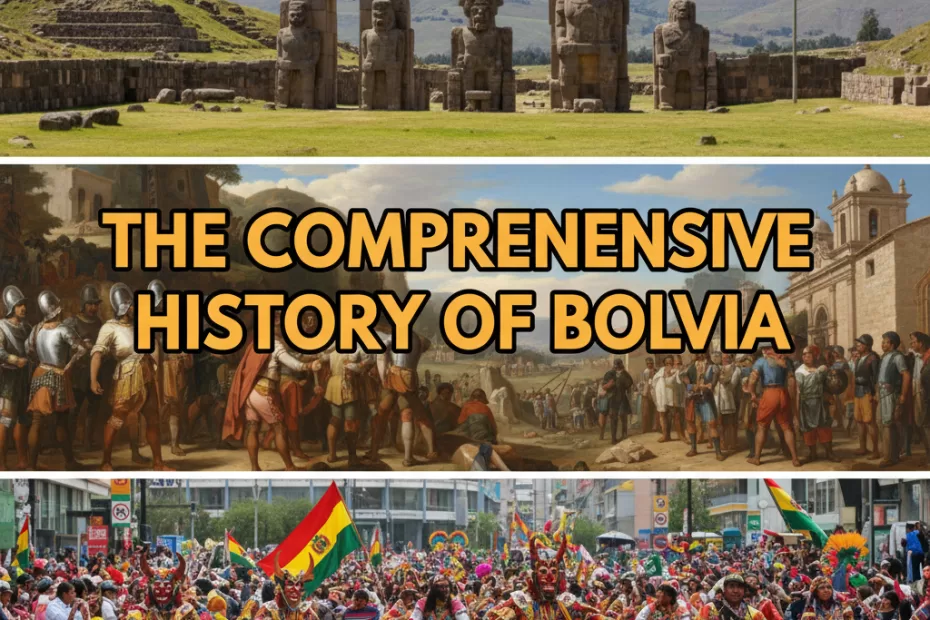
The Comprehensive History of Bolivia
Bolivia, a landlocked nation nestled in the heart of South America, boasts a history as rich and diverse as its stunning Andean landscapes. For those seeking to understand the intricate tapestry of this fascinating country, delving into the history of Bolivia in English reveals a narrative shaped by ancient civilizations, colonial exploitation, fervent struggles for independence, and a continuous quest for social justice and national identity. It’s a story of resilience, cultural fusion, and a vibrant indigenous heritage that continues to influence its present.
Introduction to Bolivia’s History
Bolivia’s unique geographical position, encompassing high-altitude plateaus, fertile valleys, and Amazonian lowlands, has played a crucial role in its historical trajectory. From the earliest human settlements to the complex political landscape of today, Bolivia’s past is a compelling journey through time. Its historical significance is immense, serving as a crucible for some of the most advanced pre-Columbian cultures in the Americas and later becoming a cornerstone of the Spanish colonial empire due to its vast mineral wealth.
The nation’s diverse cultural heritage is a direct reflection of this long and often tumultuous history. Indigenous peoples, primarily Aymara and Quechua, form a significant portion of the population, maintaining traditions, languages, and worldviews that predate the arrival of Europeans. Their enduring influence is visible in Bolivia’s art, music, festivals, and daily life, creating a unique blend of ancient Andean history and Hispanic traditions. Understanding Bolivia’s past is not merely an academic exercise; it’s an immersion into the soul of a nation that has consistently fought to define itself against external pressures and internal divisions, making its story a vital part of South American history.
Ancient Civilizations in Bolivia
Long before the Spanish conquest, the Bolivian altiplano was home to sophisticated ancient civilizations that left an indelible mark on the region. The most prominent of these was the Tiwanaku civilization, a powerful pre-Inca culture that flourished in the southern Lake Titicaca basin from around 500 to 1000 AD. Tiwanaku history is characterized by remarkable architectural and agricultural achievements, demonstrating an advanced understanding of engineering, astronomy, and social organization. Their capital city, also called Tiwanaku, was a major ceremonial and political center, with monumental structures like the Akapana pyramid, the Kalasasaya temple, and the iconic Gateway of the Sun.
The Tiwanaku people developed innovative farming techniques, such as suka kollus (raised fields), which allowed them to cultivate crops efficiently in the harsh altiplano environment, mitigating the effects of frost and drought. Their influence extended across a vast area, from present-day Peru and Chile to Argentina, spreading their distinctive artistic styles, religious beliefs, and political structures. The collapse of Tiwanaku around 1000 AD, possibly due to climate change or internal strife, led to a period of regional states and chiefdoms.
Following the decline of Tiwanaku, various Aymara kingdoms emerged, such as the Collas, Lupacas, and Pacajes, who maintained a decentralized yet influential presence in the highlands. These kingdoms were eventually absorbed into the expanding Inca Empire in the late 15th century. The Incas, originating from Cusco, Peru, incorporated much of the Andean region, including parts of modern-day Bolivia, into their vast Tawantinsuyu empire. They introduced their administrative systems, language (Quechua), and religious practices, though they often allowed local traditions to persist. The Inca presence in Bolivia was relatively brief, lasting less than a century before the arrival of the Spanish, but it further solidified the region’s rich indigenous culture and agricultural practices, building upon the foundations laid by Tiwanaku and other earlier cultures. This period of sophisticated pre-Columbian societies laid the groundwork for the unique Bolivian heritage that endures today.
Colonial Period and Spanish Conquest
The arrival of the Spanish in the early 16th century dramatically altered the course of Bolivia’s history. Francisco Pizarro’s conquest of the Inca Empire in 1532 quickly led to the subjugation of the highland regions that would become Upper Peru, or Charcas, the colonial precursor to modern Bolivia. The primary motivation for the Spanish conquest of Bolivia was the immense mineral wealth, particularly silver. In 1545, the discovery of a massive silver lode at Cerro Rico in Potosí transformed the region into one of the most important economic centers of the Spanish Empire.
Potosí rapidly grew into one of the largest cities in the world, often referred to as the “Imperial City.” Its silver fueled the Spanish economy and European trade for centuries, but at a tremendous human cost. The Spanish implemented the mita system, a forced labor draft inherited from the Incas but intensified to brutal levels, compelling indigenous populations to work in the dangerous mines. Millions of indigenous people perished from harsh labor conditions, diseases introduced by the Europeans, and malnutrition. The impact of Spanish colonization on Bolivia’s indigenous populations was devastating, leading to massive demographic decline, the destruction of traditional social structures, and the imposition of a new religion and language.
The colonial administration established the Real Audiencia de Charcas in 1559, headquartered in La Plata (modern-day Sucre), which governed a vast territory corresponding roughly to present-day Bolivia. This administrative division played a crucial role in shaping Bolivia’s future borders and identity. Spanish culture, religion (Catholicism), and legal systems were imposed, leading to a complex mestizo society where European and indigenous elements intertwined. However, indigenous resistance was persistent, manifesting in various forms from passive non-compliance to armed rebellions, such as the Túpac Katari uprising in 1781. These revolts, though ultimately suppressed, demonstrated the deep-seated grievances against colonial rule and sowed the seeds for future movements for Bolivia independence. The colonial period cemented a social hierarchy that placed Europeans at the top, followed by criollos (Spanish descendants born in the Americas), mestizos, and finally, the indigenous majority, a structure that would have long-lasting implications for Bolivia politics and society.
Independence and the Birth of a Nation
The early 19th century witnessed a wave of revolutionary fervor sweep across Spanish America, and Bolivia was no exception. The struggle for Bolivia independence was a protracted and often violent process, intertwined with the broader South American liberation movements. The first shouts for freedom in Upper Peru occurred as early as 1809 in cities like Chuquisaca (Sucre) and La Paz, preceding similar movements in other parts of the continent. However, these early uprisings were quickly suppressed by royalist forces.
The decisive phase of the independence movement came with the arrival of the liberating armies led by two of South America’s greatest heroes: Simón Bolívar and Antonio José de Sucre. After securing independence for Venezuela, Colombia, and Ecuador, Bolívar’s forces, under the command of General Sucre, advanced into Upper Peru. The Battle of Ayacucho in December 1824, fought in neighboring Peru, was a decisive victory for the patriot forces, effectively ending Spanish rule in South America.
Following Ayacucho, Sucre marched into Upper Peru, where he was met with popular support. On August 6, 1825, a constituent assembly declared the independence of the new republic, naming it “Bolívar” in honor of the liberator. Simón Bolívar himself initially drafted a constitution for the new nation, which was later renamed Bolivia. Antonio José de Sucre became Bolivia’s first president, facing the immense challenge of establishing a stable government, consolidating borders, and rebuilding an economy ravaged by years of warfare. The birth of a nation was fraught with difficulties, including internal divisions, boundary disputes with neighboring countries, and the lingering legacy of colonial social structures.
The early years of independent Bolivia were marked by instability, with frequent changes in government, military coups, and territorial conflicts. The nation lost significant portions of its territory, including access to the Pacific Ocean during the War of the Pacific (1879-1883) against Chile, a loss that continues to be a central theme in Bolivia’s national identity and foreign policy. Despite these challenges, the declaration of independence marked a pivotal moment, laying the foundation for a sovereign nation and the beginning of its complex journey as an independent republic. The period cemented a strong sense of Bolivian heritage, even as the new nation grappled with its identity and place in the world.
The 20th Century: Political Turmoil and Reforms
The 20th century in Bolivia was a period defined by profound political changes, social movements, and economic shifts. It began with the country still reeling from the loss of its Pacific coast in the War of the Pacific, a trauma that deeply affected its national psyche. The early decades saw a succession of liberal governments, often dominated by mining interests and a small elite, but the groundwork for significant social upheaval was being laid.
A pivotal event was the Chaco War (1932-1935), fought against Paraguay over disputed territory in the Gran Chaco region. This devastating conflict, which Bolivia ultimately lost, exposed the deep-seated inequalities within Bolivian society and the incompetence of its military and political leadership. The war veterans, many of whom were indigenous conscripts, returned with a new political consciousness, demanding land reform and greater inclusion. This period saw the rise of new political parties and ideologies, including socialist and nationalist movements, challenging the traditional ruling class.
The mid-century brought the most significant social transformation in Bolivia’s modern history: the 1952 National Revolution. Led by the Revolutionary Nationalist Movement (MNR), this revolution was a watershed moment, bringing about universal suffrage (extending the vote to indigenous peoples and women), nationalization of the major tin mines, and a comprehensive agrarian reform that redistributed land to indigenous peasants. These reforms fundamentally altered Bolivia’s social structure and empowered previously marginalized groups, laying the foundation for many of the social issues and political dynamics seen today. The revolution aimed to dismantle the colonial legacy of exploitation and create a more equitable society.
However, the revolutionary period was followed by decades of political instability, marked by numerous military coups and dictatorships. From the mid-1960s to the early 1980s, Bolivia experienced a cycle of authoritarian rule, often accompanied by human rights abuses and economic mismanagement. The military regimes attempted to suppress social movements and labor unions, but resistance persisted, particularly among miners and students. This era also saw the rise of figures like Ernesto “Che” Guevara, who attempted to spark a communist revolution in Bolivia in 1967, though his efforts were ultimately unsuccessful.
The return to democracy in 1982 brought hope, but also a new set of challenges. The country grappled with hyperinflation and a massive foreign debt. Neoliberal economic reforms were implemented in the mid-1980s, privatizing state-owned enterprises and opening the economy to foreign investment. While these reforms stabilized the economy, they also led to increased social inequality and widespread discontent, particularly among indigenous communities and urban poor who felt excluded from the benefits of development. The late 20th century thus set the stage for the powerful indigenous-led social movements that would define the early 21st century, continuing the complex narrative of Bolivia politics and its quest for justice.
Recent History and Contemporary Issues
The turn of the 21st century ushered in a new era for Bolivia, characterized by a resurgence of indigenous political power and a redefinition of the nation’s economic and social priorities. The discontent stemming from neoliberal policies of the late 20th century culminated in a series of social uprisings, most notably the “Water War” in Cochabamba in 2000 against the privatization of water services, and the “Gas War” in 2003, protesting the export of natural gas through Chile. These movements demonstrated the growing strength of indigenous organizations and urban popular sectors, demanding greater control over national resources and a more inclusive political system.
These protests paved the way for the election of Evo Morales Ayma in 2005, Bolivia’s first indigenous president. His election marked a historic shift, representing the culmination of centuries of struggle by indigenous peoples for recognition and political representation. Morales, a former coca farmer and leader of the Movement Toward Socialism (MAS) party, initiated a process of profound transformation. His government pursued policies aimed at empowering indigenous communities, nationalizing key industries (especially hydrocarbon resources), and redistributing wealth to reduce poverty and inequality.
Under Morales, Bolivia underwent significant constitutional reform, culminating in the 2009 Constitution, which declared Bolivia a plurinational state, recognizing its diverse indigenous nations and languages. This new framework aimed to dismantle the colonial legacy and foster a more equitable, inclusive society. Social programs were expanded, literacy rates improved, and indigenous rights were enshrined in law. Bolivia’s economy experienced a period of growth, largely fueled by high commodity prices, particularly for natural gas.
However, Morales’s presidency also faced significant challenges and controversies. Critics raised concerns about democratic backsliding, particularly his attempt to seek a fourth term despite a constitutional referendum limiting presidential terms. Political polarization intensified, leading to widespread protests in 2019 following disputed election results. Morales resigned and went into exile amid accusations of electoral fraud and pressure from the military and police.
The subsequent interim government faced its own set of challenges, including political instability and the COVID-19 pandemic. The 2020 general election saw the MAS party return to power with Luis Arce Catacora as president, signaling a continuation of many of the previous administration’s policies.
Today, Bolivia continues to grapple with a range of contemporary issues. Economic challenges include diversifying its economy beyond natural resources, addressing the impacts of climate change, and ensuring sustainable development. Social issues revolve around persistent inequalities, access to quality healthcare and education, and the ongoing struggle for full recognition and rights for all indigenous groups. Political challenges include strengthening democratic institutions, fostering national unity amidst deep polarization, and balancing resource extraction with environmental protection. Bolivia’s journey in the 21st century reflects a nation actively shaping its future, building upon its complex history and vibrant indigenous culture to forge a unique path in the global landscape. This continuous evolution makes Bolivia’s modern history a compelling study of resilience and self-determination.
Cultural Heritage: A Blend of Traditions
Bolivia’s cultural heritage is a vibrant, living testament to its diverse history, a rich tapestry woven from indigenous traditions, Spanish colonial influences, and subsequent social transformations. This unique blend is evident in every facet of Bolivian life, from its bustling city markets to its remote Andean villages.
One of the most striking aspects of Bolivian culture is its festivals. These celebrations are often a fusion of Catholic rites and ancient indigenous spiritual practices, making them incredibly colorful and deeply meaningful. The Carnaval de Oruro, recognized by UNESCO as a Masterpiece of the Oral and Intangible Heritage of Humanity, is perhaps the most famous. It’s a spectacular display of elaborate costumes, traditional dances like the diablada (dance of the devils), and a profound devotion to the Virgen del Socavón (Virgin of the Mines), reflecting both Catholic faith and indigenous reverence for Pachamama (Mother Earth) and the Tío (god of the underworld in the mines). Other significant festivals include Gran Poder in La Paz, celebrating the Lord of Great Power with lavish parades, and local harvest festivals that honor ancestral deities. These events are crucial for understanding Bolivia traditions and the deep spiritual connection many Bolivians have to their land and heritage.
Music and dance are integral to Bolivian cultural expression. Traditional Andean music, characterized by instruments like the siku (panpipes), quena (flute), and charango (a small, stringed instrument), evokes the vastness of the altiplano and the resilience of its people. Each region and indigenous group has its distinct musical styles and dances, telling stories of history, love, and everyday life. The morenada, with its heavy, rhythmic steps, symbolizes the suffering of African slaves brought to the mines, while the caporales dance, though more modern, also draws on Afro-Bolivian influences. Contemporary Bolivian music often blends these traditional sounds with cumbia, folk, and rock, creating a dynamic and evolving soundscape.
Bolivian art reflects this same synthesis. Colonial art often depicted religious themes, blending European styles with indigenous iconography and interpretations. Today, indigenous art forms, such as intricate textiles woven with ancient symbols and vibrant colors, continue to thrive. Modern Bolivian art addresses social issues, indigenous identity, and the country’s complex political history, providing a visual narrative of Bolivia society.
The culinary traditions of Bolivia are equally diverse and delicious. Staples like potatoes (Bolivia is a center of potato diversity), corn, quinoa, and various chilies form the basis of many dishes. Iconic foods include salteñas (savory baked empanadas), ajiaco (a hearty soup), fricasé (pork stew), and pique macho (a spicy platter of meat, sausages, and vegetables). Each region boasts its specialties, reflecting the availability of local ingredients and historical influences. These culinary practices are not just about food; they are about community, family, and the preservation of Bolivian heritage.
Bolivia’s demographics are a testament to its cultural diversity, with a significant proportion of its population identifying as indigenous, alongside mestizo and smaller Afro-Bolivian and European communities. This diversity is celebrated and protected, especially under the plurinational state framework established in the 21st century. The country’s rich oral traditions, literature, and indigenous languages (Aymara and Quechua alongside Spanish) further underscore the depth of its cultural wealth. The blend of these elements creates a uniquely Bolivian identity, one that is deeply rooted in its past yet constantly evolving, making the study of Bolivia’s cultural diversity an essential part of understanding the nation’s heart.
Conclusion: The Future of Bolivia
The history of Bolivia in English reveals a nation forged in the crucible of ancient civilizations, colonial exploitation, and unwavering struggles for self-determination. From the monumental achievements of Tiwanaku to the complexities of modern political movements, Bolivia’s timeline is a testament to the enduring spirit of its people. It’s a journey marked by profound historical events, from the unparalleled wealth extracted from Potosí to the transformative 1952 Revolution and the groundbreaking election of its first indigenous president.
Bolivia stands today at a critical juncture, navigating the challenges of economic development, social equity, and political stability while striving to preserve its extraordinary cultural heritage. The lessons learned from centuries of foreign domination and internal conflict have instilled a strong sense of national identity and a deep commitment to indigenous rights and environmental stewardship. The nation continues to grapple with the legacy of its past, particularly the inequalities inherited from the colonial era and the territorial losses that shaped its geography.
Looking ahead, the future of Bolivia will undoubtedly be shaped by its ability to harness its rich natural resources responsibly, foster inclusive economic growth, and strengthen its democratic institutions. The vibrant energy of its social movements, particularly those advocating for indigenous peoples and environmental protection, will continue to play a crucial role in shaping its direction. Bolivia’s unique position as a plurinational state, actively embracing its diverse cultures and languages, offers a powerful model for other nations grappling with similar issues of identity and inclusion.
The narrative of Bolivia is far from over. It is a dynamic story of resilience, cultural fusion, and an ongoing quest for justice and a truly sovereign future. As the world becomes increasingly interconnected, understanding Bolivia’s historical journey offers invaluable insights into the broader themes of colonialism, indigenous empowerment, and the enduring human struggle for dignity and self-determination. The Bolivian people, with their rich traditions and unwavering spirit, continue to write the next chapters of their compelling history.
Whatispin77pro is the place to be! Been winning and having a blast . Recommended! Check it out: whatispin77pro.