
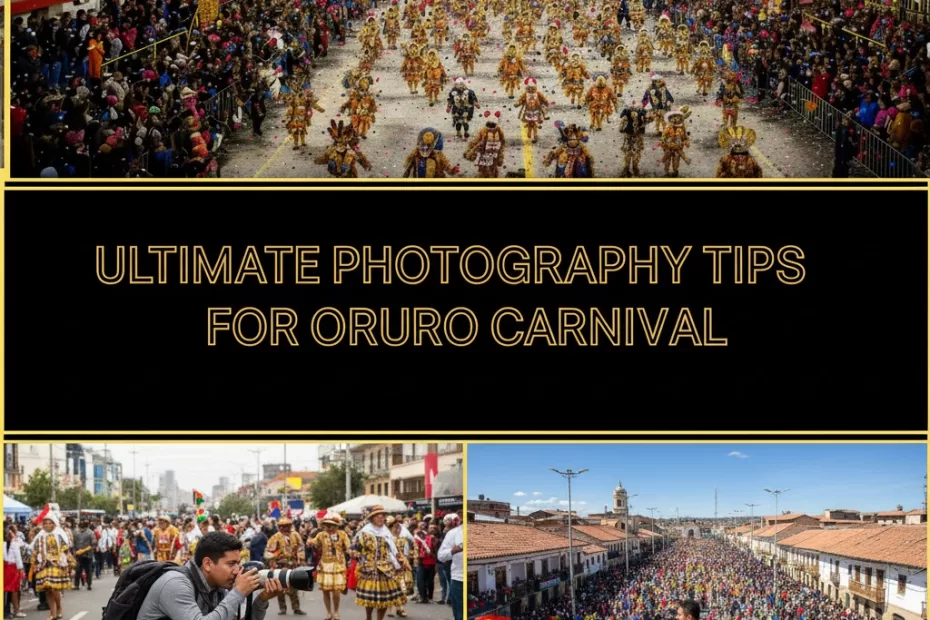
Ultimate Photography Tips for Oruro Carnival
The Oruro Carnival in Bolivia is not just a festival; it’s a living, breathing canvas of color, sound, and fervent tradition. For photographers, it presents an unparalleled opportunity to capture a spectacle unlike any other on Earth. From the intricate details of thousands of dazzling costumes to the raw emotion etched on the faces of dancers and musicians, every moment is a potential masterpiece waiting to be framed. These photography tips for Oruro Carnival are designed to help you navigate the chaos and beauty, ensuring you come away with truly stunning images that tell the story of this incredible cultural event.
Introduction to Oruro Carnival
Imagine a vibrant tapestry woven from centuries of tradition, faith, and artistic expression, set against the high-altitude backdrop of the Bolivian Andes. That’s the Oruro Carnival. Recognized by UNESCO as a Masterpiece of the Oral and Intangible Heritage of Humanity, this carnival is far more than just a party; it’s a profound religious and cultural phenomenon that draws hundreds of thousands of participants and spectators each year.
Its origins are deeply rooted in a fascinating syncretism of indigenous Andean beliefs and Catholic traditions. Before the arrival of the Spanish, the Uru people of the region celebrated Anata, a festival of abundance and fertility dedicated to Pachamama (Mother Earth) and the Supay (devil-like figures). When the Spanish introduced Catholicism, these ancestral traditions merged with Christian narratives, particularly the Feast of the Virgin of Socavón, the patron saint of miners. The result is a unique spiritual drama where pagan deities and Christian saints coexist, celebrated with an awe-inspiring display of devotion and artistry.
The carnival culminates in a grand procession, the “Entrada,” where more than 28,000 dancers and 10,000 musicians perform over a 4-kilometer route, sometimes for 20 hours straight. Each dance group, known as a “comparsa,” represents a specific cultural tradition, with the Diablada (Dance of the Devils) being the most iconic. Its elaborate masks and costumes symbolize the eternal struggle between good and evil, a central theme of the carnival. Other prominent dances include the Morenada, Caporales, and Tobas, each with its own history, intricate choreography, and spectacular attire.
For photographers, the Oruro Carnival is a sensory overload in the best possible way. The sheer scale of the event, the kaleidoscope of colorful costumes, the rhythmic pulse of the music, and the palpable emotion of the participants offer endless opportunities for captivating Bolivia festival photography. Capturing the movement, the intricate patterns, the expressions, and the overall atmosphere requires not just technical skill, but also an understanding and respect for the cultural significance of what you are witnessing. It’s an experience that transcends mere observation; it’s an immersion into the very soul of Bolivia culture, and an incredible chance for cultural photography.
Best Photography Spots at the Carnival
Navigating the bustling streets of Oruro during carnival can be a challenge, but knowing the prime photography locations Oruro offers will significantly enhance your chances of securing those iconic shots. The main parade route stretches several kilometers, providing numerous vantage points, each with its own advantages for capturing the vibrant photography of the event.
One of the most sought-after spots is near the start of the parade route, usually around the Plaza 10 de Febrero and the surrounding streets. Here, dancers and musicians are often at their freshest, full of energy and enthusiasm. The light in the morning hours can be particularly soft and flattering, perfect for highlighting the intricate details of the colorful costumes. While crowds can be dense, arriving early to secure a spot along the barricades, or even looking for a balcony spot in one of the buildings overlooking the plaza, can yield fantastic wide-angle shots of the initial momentum and excitement. From an elevated position, you can capture the sprawling scale of the procession as it begins, showing the sheer number of participants.
As the parade progresses, the main avenues like Calle Pagador and Calle Bolivar become excellent locations. These wider streets allow for more dynamic shots, especially when groups of dancers spread out. Look for spots where the sun hits the street at an angle, creating interesting shadows and highlights that add depth to your images. Street-level photography here allows for intimate portraits and action shots, capturing the raw energy of the performers up close. It’s also a great place to observe the interactions between the dancers and the crowd, adding a human element to your festival photography tips. Try to find a slightly elevated curb or a small step to get a better perspective over the heads of the immediate crowd.
A crucial point along the route is the Sanctuary of the Virgin of Socavón. This is where the dancers make their final, most heartfelt pilgrimage, often dropping to their knees to approach the altar. The emotion here is palpable, offering profound opportunities for capturing genuine expressions of devotion and exhaustion. The area around the sanctuary can be incredibly crowded, so planning ahead is essential. Consider arriving hours before the main groups to secure a good position, perhaps from a slightly elevated platform if available, or by finding a spot directly across from the church entrance to capture the dancers’ faces as they approach. The lighting can be tricky inside and around the church, so be prepared to adjust your camera settings for varying conditions.
Another excellent area is along the final stretch of the parade, particularly near the mining monument or where the dancers disperse. While they might be tired, their expressions of accomplishment and joy can be incredibly powerful. The late afternoon and early evening light can cast a beautiful golden glow, ideal for dramatic silhouettes or warmly lit portraits. This area often sees a slight thinning of the crowd compared to the absolute peak spots, potentially offering a bit more room to maneuver and experiment with different angles and perspectives.
For those seeking a unique perspective, consider exploring side streets or areas where groups are preparing or taking short breaks. These “behind the scenes” moments can offer a more candid and intimate look at the participants, allowing you to capture details of their costumes, their camaraderie, and their pre-performance rituals. Always be respectful and ask for permission if you are getting very close or taking portraits. Local photographers Oruro often have favorite hidden spots, so engaging with them or local residents can sometimes lead to invaluable insider tips. Ultimately, the best photography spots at the Oruro Carnival are those where you can find a balance between good light, manageable crowds, and a clear line of sight to the captivating spectacle.
Essential Photography Tips for Oruro Carnival
Capturing the essence of the Oruro Carnival demands more than just pointing and shooting; it requires thoughtful preparation and quick reflexes. The event is a whirlwind of motion, color, and emotion, making specific photography tips for Oruro Carnival invaluable for photographers of all skill levels. Here’s how to perfect your camera settings, composition, and approach to light to truly encapsulate the carnival’s spirit.
Mastering Camera Settings
Shutter Speed: This is perhaps your most critical setting for capturing movement. To freeze the fast-paced dances and energetic musicians, you’ll generally want a fast shutter speed, typically 1/500s or faster. For the Diablada’s powerful leaps or the Caporales’ dynamic kicks, 1/800s or even 1/1000s might be necessary. However, don’t be afraid to experiment with slightly slower shutter speeds (e.g., 1/125s to 1/250s) to introduce a sense of motion blur, especially in the dancers’ limbs, while keeping their faces sharp. This can add dynamism and a feeling of speed to your carnival photo tips.
Aperture (f-stop): Your aperture will dictate your depth of field. For isolating a single dancer or a small group against a blurred background, a wider aperture (smaller f-number like f/2.8 or f/4) is ideal. This helps to make your subject pop and emphasizes their vibrant photography. If you want to capture a larger group in sharp focus, or show more of the bustling background to give context, a narrower aperture (larger f-number like f/8 or f/11) would be more appropriate. In a crowded environment, a slightly narrower aperture can also be forgiving if your focus isn’t perfectly precise.
ISO: With the sun often high and bright, you’ll want to keep your ISO as low as possible (e.g., ISO 100-400) to minimize noise and maximize image quality. However, as the day progresses or if you find yourself in shaded areas or attempting night shots, you’ll need to increase your ISO. Don’t be afraid to push it to ISO 800, 1600, or even higher if necessary to maintain a fast enough shutter speed. Modern cameras handle higher ISOs remarkably well, and a slightly noisy but sharp photo is always preferable to a perfectly clean but blurry one.
White Balance: The Oruro Carnival is a riot of colors, and accurate white balance is key to capturing them faithfully. While “Auto White Balance” works well in many situations, consider setting a custom white balance or using presets like “Daylight” or “Cloudy” to ensure consistency, especially if you’re shooting in RAW format, which gives you more flexibility in post-processing.
Composition Tips for Oruro Carnival
Rule of Thirds: This fundamental composition guideline is your best friend. Place your subjects – a dancer’s face, a striking mask, or a musical instrument – at the intersections of the imaginary grid lines for a more balanced and engaging image.
Leading Lines: The parade route itself, the lines of dancers, or even the patterns on their costumes can create leading lines that draw the viewer’s eye into your photograph. Use these to guide attention to your main subject or to create a sense of depth and movement.
Capturing Emotion: Beyond the spectacle, the Oruro Carnival is deeply emotional. Look for moments of intense concentration, joy, exhaustion, devotion, or camaraderie. Zoom in on faces, hands, or subtle gestures. These are the details that tell a story and add profound depth to your cultural photography. Don’t just photograph the dance; photograph the dancer’s soul.
Details and Patterns: The costumes are incredibly elaborate. Dedicate time to capturing close-ups of the intricate embroidery, the shimmering sequins, the feathers, and the unique masks. These details add texture and richness to your portfolio and highlight the incredible craftsmanship involved in the carnival traditions.
Oruro Carnival Best Angles: Experiment! Don’t just shoot from eye level. Get low for a dramatic perspective that makes dancers appear larger than life, or find elevated spots to capture the sweeping scale of the procession. Shooting from slightly above can also help isolate subjects from dense crowds. Look for reflections in puddles after a rain shower, or use architectural elements to frame your shots.
Lighting and Challenges
The Bolivian high-altitude sun can be intense, creating harsh shadows and blown-out highlights. Try to shoot with the sun at your back or to the side for more even lighting. Overcast days, while less common, offer beautifully diffused light. In bright sun, using a fill flash can help soften harsh shadows on faces.
Crowds are an inevitable part of the Oruro Carnival experience. Patience is key. Be prepared to wait for clear shots or use a longer lens to zoom past immediate obstacles. Sometimes, embracing the crowd and using it as a foreground element can also create a sense of immersion. Always be aware of your surroundings and protect your gear. These event photography tips are crucial for navigating such a dynamic environment.
By mastering these essential photography tips for Oruro Carnival, you’ll be well-equipped to capture the unparalleled energy, color, and spiritual depth of this magnificent festival.
Cultural Significance of the Carnival
To truly capture the Oruro Carnival with your lens, it’s essential to look beyond the dazzling spectacle and delve into its profound cultural and spiritual significance. This isn’t just a party; it’s a centuries-old narrative enacted annually, a rich tapestry of beliefs, myths, and devotion that forms the bedrock of Bolivia culture. Understanding this depth will allow your cultural photography to resonate with authenticity and respect.
At its heart, the carnival is a vibrant manifestation of religious syncretism, a fusion of indigenous Andean cosmology and colonial Catholicism. For the Uru people, the region’s original inhabitants, the land was alive with spirits. Pachamama, the Earth Mother, governed fertility and abundance, while the Supay, often depicted as a devil-like figure, was a lord of the underworld, guardian of minerals, and a powerful, ambivalent force. With the arrival of theish, these figures were not eradicated but rather integrated into the Christian framework. The Supay, for example, transformed into the Christian devil, though still retaining some of his original characteristics as a benevolent protector of miners, especially during the celebrations for the Virgin of Socavón.
The central figure of the carnival is the Virgin of Socavón, the patron saint of miners. The entire elaborate procession, known as the Entrada, is a pilgrimage in her honor. Dancers and musicians endure hours of strenuous performance, often on little sleep and at high altitude, as an act of faith and devotion to the Virgin. Many make promises (promesas) to her, vowing to dance for three or seven consecutive years in exchange for blessings or protection. Capturing the moments of intense devotion, the weary but determined faces, and the final reverence at the sanctuary provides powerful insights into the spiritual core of the event.
The traditional costumes are not merely decorative; they are narratives in themselves, rich with symbolism and history. Each dance group, or “comparsa,” tells a specific story or represents a particular aspect of Andean culture.
-
The Diablada (Dance of the Devils): This is the most iconic and visually striking dance. The elaborate devil masks, often weighing several kilograms, are masterpieces of craftsmanship, adorned with snakes, toads, and dragons – symbols of the underworld and the Supay. The dancers, dressed in shimmering, often red, costumes, represent the struggle between good and evil, with the Archangel Michael often leading the charge against the devils. Capturing the fierce expressions of the devils, the intricate details of their masks, and their dramatic movements is central to Oruro Carnival photography.
-
The Morenada: This dance depicts the suffering of African slaves brought to the mines of Bolivia. The dancers wear heavy, wide-skirted costumes resembling the traditional dress of African slaves, and their distinctive masks often feature exaggerated features, symbolizing the exhaustion and suffering endured. The slow, heavy steps mimic the arduous work in the mines. The rich textures and historical depth of these costumes offer incredible opportunities for cultural photography.
-
The Caporales: A more modern dance, the Caporales is energetic and visually spectacular, often representing the overseers (caporales) of the African slaves. Dancers wear elaborate, often sequined, outfits with high boots and carry whips. Their powerful, athletic movements are a photographer’s dream for capturing dynamic action shots and the vibrant photography inherent in the festival.
-
The Tobas: This dance is an homage to the indigenous people of the Bolivian lowlands, characterized by feathered headpieces and costumes that evoke jungle animals. The movements are agile and expressive, imitating hunting and tribal rituals.
Beyond the specific dances, the entire atmosphere is steeped in cultural significance. The music, played by thousands of brass and percussion instruments, is not just accompaniment; it’s the heartbeat of the carnival, driving the dancers and spectators alike. The “prestes,” individuals or families who sponsor the carnival events, demonstrate their commitment to their community and faith through lavish hospitality and financial contributions.
For photographers, approaching the carnival with an understanding of these traditions transforms your mission from simply documenting an event to interpreting a profound cultural narrative. It encourages you to seek out the subtle gestures of devotion, the pride in heritage, and the enduring spirit of the Bolivian people. This deeper appreciation ensures your photography tips for Oruro Carnival go beyond technical advice, guiding you to capture the very soul of the festival.
Behind the Scenes: Preparing for the Carnival
Successful Oruro Carnival photography isn’t just about what happens during the parade; it’s heavily reliant on meticulous preparation beforehand. The sheer scale of the event, coupled with the high altitude and logistical challenges of Oruro, Bolivia, demands foresight, planning, and the right gear. Thinking “behind the scenes” about your own readiness will make all the difference in capturing the carnival’s vibrant photography.
Photography Gear for Festivals
Choosing the right photography gear for festivals like Oruro Carnival is paramount.
-
Camera Body: A reliable DSLR or mirrorless camera with good low-light performance and a fast continuous shooting mode is ideal for capturing the dynamic movement. A secondary body can be a lifesaver if your primary fails or if you want to quickly switch between different focal lengths without changing lenses.
-
Lenses: This is where versatility shines.
-
Wide-angle lens (e.g., 16-35mm or 24-70mm): Essential for capturing the grand scale of the parade, the sprawling crowds, and the overall atmosphere. It’s also great for street scenes and cultural photography.
-
Telephoto lens (e.g., 70-200mm or 100-400mm): Crucial for isolating dancers, musicians, and intricate costume details from a distance, especially when crowds prevent close access. This will be your workhorse for capturing expressions and precise movements.
-
Prime lens (e.g., 50mm f/1.4 or 85mm f/1.8): If you’re looking for stunning portraits with beautiful bokeh, a fast prime lens is invaluable, especially in lower light conditions or for capturing intimate moments.
-
-
Batteries and Memory Cards: Bring many spares. You’ll be shooting continuously for long periods. At least 3-4 extra batteries and multiple high-capacity memory cards (e.g., 64GB or 128GB) are a minimum. High-speed cards are essential for burst shooting.
-
Camera Bag: A comfortable, durable, and secure backpack that allows quick access to your gear is a must. Consider one with anti-theft features.
-
Protection: Dust, potential rain, and splashes from water balloons are all possibilities. Bring a rain cover for your camera and lenses, and consider a UV filter for lens protection. A small towel or cloth is useful for wiping off sweat or moisture.
-
Cleaning Kit: Dust is prevalent, especially from the dry streets. A lens pen, micro-fiber cloths, and a blower will help keep your optics clean.
-
Monopod/Tripod: While a full tripod might be too cumbersome in dense crowds, a monopod can offer stabilization for longer lenses or lower light, without taking up too much space. It’s also useful for long exposure shots if you find a stable spot away from the main crush.
Physical and Logistical Preparation
-
Altitude Sickness: Oruro is at an elevation of approximately 3,700 meters (12,140 feet). If you’re not acclimatized, plan to arrive a few days early to adjust. Drink plenty of water, avoid alcohol, and take it easy. Carrying coca leaves or sorojchi pills can help alleviate symptoms. Physical stamina is important for event photography tips, especially at this altitude.
-
Comfortable Footwear: You’ll be on your feet for hours, walking, standing, and maneuvering through crowds. Comfortable, supportive shoes are non-negotiable.
-
Hydration and Snacks: Carry water bottles and high-energy snacks. Staying hydrated and fueled is crucial for maintaining focus and energy throughout the long days.
-
Sun Protection: The sun at high altitude is intense. Bring sunscreen, a wide-brimmed hat, and sunglasses.
-
Safety and Security: Pickpocketing can be an issue in large crowds. Keep your gear secure and close to your body. Avoid displaying expensive equipment unnecessarily. Consider using a camera strap that’s difficult to snatch. Travel photography tips always emphasize awareness of your surroundings.
-
Permits and Accreditation: While general street photography doesn’t usually require special permits, if you plan to access restricted areas, elevated platforms, or want official accreditation (which can offer better access), inquire well in advance with local tourism boards or carnival organizers. Local photographers Oruro might have insights into this.
-
Scouting Locations: If possible, arrive a day or two before the main events to scout the parade route. Identify potential vantage points, consider sun direction at different times of day, and note down any elevated spots or strategic corners. This foresight can be a game-changer for finding the Oruro Carnival best angles.
-
Respect Local Traditions: Always be respectful of the performers and their traditions. Ask for permission before taking close-up portraits, especially of individuals who might be in a moment of deep devotion. Remember, this is a spiritual event, not just a photo opportunity. Embracing the Oruro Carnival experience means respecting its cultural significance.
By meticulously preparing both your gear and yourself, you’ll be ready to fully immerse in the Oruro Carnival experience and capture the incredible stories unfolding before your lens. This comprehensive event preparation is key to successful Bolivia festival photography.
Interviews with Local Photographers
To truly understand the nuances of capturing the Oruro Carnival, there’s no better source than the local photographers Oruro who have dedicated their lenses to this annual spectacle for years. Their insights offer a unique perspective, blending technical expertise with a deep appreciation for the cultural significance of the event. While I can’t conduct live interviews, I can synthesize common themes and advice that often emerge from discussions with those who know the carnival best.
One recurring piece of advice from local lensmen and women is the importance of patience and persistence. “The carnival isn’t a sprint; it’s a marathon,” explains one seasoned photographer, “You can’t expect to get all the shots in the first hour. The best moments often happen unexpectedly, or after hours of waiting. You need to be ready for the long haul, both physically and mentally.” This means finding a good spot and being prepared to hold it, or moving strategically when opportunities arise, rather than constantly battling the crowds.
Another key insight revolves around respect and immersion. “Many foreign photographers come seeking just the ‘pretty’ pictures of the costumes,” notes a local photojournalist, “but the real story is in the devotion, the sweat, the exhaustion, the camaraderie. You have to understand that this is a spiritual journey for many. Approach with respect, ask permission for close-ups, and try to feel the emotion. That’s what will make your carnival photo tips truly stand out.” This emphasis on cultural photography over mere documentation is vital for capturing the true Oruro Carnival experience. They often suggest learning a few basic phrases in Spanish or Quechua to facilitate connection with the performers.
When it comes to technical aspects, local photographers often highlight the challenges of lighting and movement. “The sun can be harsh, and the dances are incredibly fast,” advises another photographer, “Mastering your shutter speed is non-negotiable. Don’t be afraid to push your ISO when the light fades, especially for the evening processions or when groups pass through shaded areas. A sharp, slightly noisy photo is always better than a blurry one.” They also suggest paying close attention to white balance, as the vibrant colors of the costumes can be tricky to render accurately under varying light conditions.
They also emphasize getting beyond the obvious shots. “Everyone gets the wide shots of the Diablada,” a local artist points out, “but look for the details: the intricate embroidery on a Morenada dancer’s skirt, the weary but joyful expression of a musician, the hands of a Caporales dancer, the interaction between a child and a performer. These are the elements that add depth and uniqueness to your Oruro Carnival photography.” They often recommend a good telephoto lens (e.g., 70-200mm or longer) for these detail shots, allowing them to capture intimate moments without intruding on the dancers’ space.
Finally, local experts stress the importance of pre-scouting and flexibility. “I walk the route days before, looking at the light, potential obstacles, and escape routes,” shares a photographer who has covered the carnival for two decades. “But you also have to be flexible. The carnival has its own rhythm, and things don’t always go according to plan. Be ready to adapt, to change your Oruro Carnival best angles, and to embrace the unexpected.” They also advise photographers to be mindful of their gear, recommending sturdy straps and secure bags to protect against both accidental bumps and potential theft in the dense crowds.
These insights from local photographers Oruro underscore that successful Bolivia festival photography, especially at an event as culturally rich as the Oruro Carnival, requires a blend of technical prowess, cultural sensitivity, and an adventurous spirit. Their advice is a testament to the fact that the best images come from those who not only see the spectacle but also feel its heartbeat.
Post-Processing Tips for Carnival Photos
Once you’ve navigated the crowds, battled the sun, and captured thousands of unforgettable moments at the Oruro Carnival, the journey isn’t over. Post-processing is where you truly bring your images to life, enhancing the vibrant photography and ensuring they accurately reflect the energy and color you witnessed. These post-processing tips for carnival photos will help you refine your shots, making them pop with the spirit of the festival.
Enhancing Vibrancy and Color
The Oruro Carnival is a kaleidoscope of color, and your editing should reflect that.
-
White Balance Correction: Even if you tried to get it right in-camera, fine-tuning your white balance is crucial. Use the eyedropper tool on a neutral gray or white area in your image, or manually adjust temperature and tint sliders until the colors look natural and true to the scene. This is especially important for accurately representing the colorful costumes.
-
Saturation and Vibrance: These are your best friends for carnival photos. Increase vibrance first, as it selectively boosts less saturated colors, preventing skin tones from looking overcooked. Then, make subtle adjustments to saturation to make the reds, blues, greens, and golds of the costumes truly sing. Be careful not to overdo it, as colors can quickly look artificial. The goal is vibrant, not garish.
-
HSL (Hue, Saturation, Luminance) Adjustments: For precise control, dive into the HSL panel. If a specific color, like a dancer’s blue skirt or a red devil mask, isn’t quite right, you can adjust its hue, saturation, and luminance independently without affecting other colors. This is invaluable for fine-tuning the intricate details of the traditional costumes.
Improving Contrast and Dynamic Range
The harsh Bolivian sun can lead to images with high contrast, blown-out highlights, and crushed shadows.
-
Highlights and Shadows: Reduce highlights to recover detail in bright areas (like white feathers or shiny sequins) and lift shadows to reveal details in darker areas (like the folds of a costume or shaded faces).
-
Whites and Blacks: Adjusting the white and black points can give your image more punch. Push whites up for brighter brights and blacks down for deeper blacks, but always keep an eye on your histogram to avoid clipping.
-
Clarity and Dehaze: A slight increase in clarity can add definition and texture to your images, making details in masks and embroidery more prominent. Dehaze can be useful for cutting through any atmospheric haze, especially in wider shots of the parade route.
Sharpening and Noise Reduction
-
Sharpening: After making global adjustments, apply sharpening. Zoom in to 100% and apply sharpening carefully, focusing on edges and details. Avoid over-sharpening, which can introduce artifacts.
-
Noise Reduction: If you had to use a high ISO, your images might have some digital noise. Apply noise reduction judiciously. Start with luminance noise reduction to smooth out graininess, and then chromatic noise reduction to remove color speckles. Remember that too much noise reduction can soften details, so find a balance.
Cropping and Composition Refinement
-
Cropping: Use cropping to refine your composition. Straighten horizons, remove distracting elements from the edges, or crop tighter to emphasize a particular expression or detail. Remember the rule of thirds even in post-processing – use it to re-frame your subject for a more impactful image.
-
Perspective Correction: If you shot from a low or high angle, or slightly off-center, you might have some converging lines. Use perspective correction tools to straighten buildings or other vertical elements, giving your image a more professional look.
Local Adjustments
Don’t forget the power of local adjustments.
-
Brush Tool: Use a brush to selectively brighten faces, darken distracting backgrounds, or add a pop of contrast to a specific costume element.
-
Radial and Graduated Filters: These are excellent for controlling light in specific areas, such as darkening a bright sky or subtly brightening a group of dancers.
Workflow and Consistency
-
Batch Editing: For similar images, create a preset or copy and paste your adjustments to maintain consistency across your series.
-
Export Settings: When exporting, ensure you choose appropriate settings for your intended use (e.g., high-resolution JPEGs for printing, smaller JPEGs for web).
Post-processing is an integral part of the Oruro Carnival photography process. It’s where you transform raw captures into compelling visual stories, enhancing the cultural significance and ensuring your vibrant photography truly reflects the magic of this incredible festival. Take your time, experiment, and let the spirit of Oruro guide your edits.
Conclusion and Final Thoughts
The Oruro Carnival is an experience that transcends mere observation; it’s an immersion into the very soul of Bolivia, a breathtaking display of faith, tradition, and human artistry. For photographers, it represents a unique and exhilarating challenge, offering unparalleled opportunities to capture stories woven in vibrant color, dynamic movement, and profound emotion. From the moment the first dancer steps onto the route until the final weary steps at the Sanctuary of the Virgin of Socavón, every second is a photographic treasure waiting to be discovered.
We’ve journeyed through the intricate history and cultural significance of this UNESCO-recognized masterpiece, understanding that the dazzling costumes and energetic dances are much more than a spectacle – they are expressions of deep-rooted beliefs and ancestral narratives. We’ve explored the best photography locations Oruro offers, from the bustling start of the parade to the emotionally charged final pilgrimage, helping you identify the Oruro Carnival best angles to frame your shots.
The essential photography tips for Oruro Carnival have armed you with the technical know-how to conquer the challenges of light and motion, emphasizing the critical role of shutter speed, aperture, and ISO in freezing the action or conveying a sense of dynamism. We delved into composition, urging you to seek out emotion, intricate details, and unique perspectives that elevate your carnival photo tips beyond the ordinary.
Our “behind the scenes” look at event preparation underscored the importance of the right photography gear for festivals, from versatile lenses to an abundance of batteries and memory cards. Crucially, it highlighted the necessity of physical and logistical readiness, including acclimatization to Oruro’s high altitude and a keen awareness of safety and cultural respect – vital travel photography tips for any large cultural event. Insights from local photographers Oruro further reinforced the value of patience, immersion, and looking for the deeper narrative in your cultural photography. Finally, the post-processing tips for carnival photos provided the tools to enhance your vibrant photography, ensuring the colors pop and the stories resonate long after the festival concludes.
Ultimately, Oruro Carnival photography is about more than just snapping pictures; it’s about witnessing and interpreting a living tradition. It’s about respecting the performers, understanding their devotion, and allowing yourself to be swept up in the raw energy of the moment. So, pack your bags, prepare your gear, and open your heart to the incredible Oruro Carnival experience. Embrace the unexpected, engage with the culture, and let your lens tell the unforgettable story of this extraordinary festival. May your images be as vibrant and soulful as the carnival itself.
Betvnd888, you say? Honestly, I was skeptical at first, but their customer service is great and the site itself is well-designed. Worth checking out if you ask me. betvnd888
Honestly, reading about the psychology aspect is key; it’s more than just knowing the Sun win game mechanics. The emphasis on emotional control really resonated with my own research findings here. Great depth!