
Bolivian Folklore Dances Explained
Bolivia, a landlocked country nestled in the heart of South America, boasts an incredibly rich and vibrant cultural tapestry. At the very core of this cultural identity are its spectacular folklore dances. These aren’t just mere performances; they are living, breathing narratives that tell tales of indigenous heritage, colonial history, religious devotion, and the everyday lives of its people. From the bustling streets of La Paz to the high-altitude plains of the Altiplano, dance is an intrinsic part of Bolivian society, reflecting a profound connection to tradition and an unwavering spirit of celebration.
Understanding Bolivian folklore dances means delving into centuries of history, exploring the intricate fusion of pre-Columbian beliefs with Spanish colonial influences, and appreciating the resilience and creativity of various indigenous groups. Each step, every twirl, and the elaborate costumes worn by dancers carry deep cultural significance, making these performances a powerful expression of Bolivia’s unique heritage. These dance styles are not static; they evolve, yet always remain rooted in the stories and experiences that have shaped the nation. They are a visual and auditory feast, an essential component of any Bolivian festival or cultural event, captivating audiences with their energy, symbolism, and sheer beauty.
Introduction to Bolivian Folklore Dances
The sheer diversity of Bolivian folklore dances is astounding, a direct reflection of the country’s diverse geography and its multicultural population, comprising numerous indigenous groups like the Quechua, Aymara, Guarani, and many others. These dances are far more than just entertainment; they serve as a crucial vehicle for preserving history, transmitting cultural values, and reinforcing community bonds. They are a dynamic form of storytelling, recounting myths, historical events, social commentaries, and religious narratives that have been passed down through generations.
The significance of these traditional Bolivian dance styles extends to every facet of life. During major festivals and celebrations, entire communities come alive, with people of all ages participating in exuberant dance performances. This collective participation fosters a strong sense of belonging and cultural identity. The music, the elaborate traditional Bolivian costumes, and the intricate choreographies all combine to create an immersive experience that is both deeply spiritual and incredibly joyful. From the solemn rhythms reflecting ancient rituals to the lively tunes celebrating bountiful harvests, Bolivian folklore offers a window into the soul of its people, embodying their resilience, faith, and enduring spirit. These dances are an integral part of Bolivia cultural heritage, offering a unique blend of indigenous roots and colonial influences that sets them apart within Latin American dance traditions.
Major Types of Bolivian Folklore Dances
Bolivia is home to hundreds of distinct dance forms, each with its own unique origins, music, and characteristics. However, some stand out for their widespread popularity, historical depth, and profound cultural significance. Among the most iconic are Morenada, Diablada, and Caporales, each telling a compelling story through its movements and attire. These dances are pillars of Bolivian folklore, celebrated with immense passion and pride, especially during major Bolivian festivals.
Morenada
The Morenada is perhaps one of the most recognizable and beloved Bolivian dance styles, known for its distinctive heavy steps and elaborate costumes. The history of Morenada dance is deeply intertwined with the country’s colonial past and the tragic realities of African slavery. While its exact origins are debated, a widely accepted theory suggests it emerged as a satirical portrayal of African slaves brought to the high-altitude silver mines of Potosí during the Spanish colonial era. The “morenos” (dark-skinned people) would carry heavy loads, and their slow, deliberate steps are said to mimic the arduous walk of chained slaves, often burdened with lead ore. The rhythmic sound of the matracas (rattles) carried by the dancers is believed to represent the rattling of chains.
The costumes in Morenada are among the most elaborate in Bolivian folklore. Male dancers wear enormous, intricately decorated masks, often depicting exaggerated features with bulging eyes and thick lips, sometimes adorned with grapes, symbolizing the wine consumed by the slave drivers. Their attire includes heavily embroidered capes, wide-brimmed hats, and large boots, all adding to the imposing silhouette and the heavy, almost lumbering, dance style. Female dancers, or cholitas, wear elegant polleras (layered skirts), blouses, and distinctive bowler hats. The meaning behind Morenada dance is complex, serving as both a remembrance of a painful historical period and a vibrant celebration of resistance and cultural survival, transforming suffering into a powerful artistic expression. Its profound historical narrative makes it a cornerstone of Bolivian folklore explanations.
Diablada
The Diablada, or “Dance of the Devils,” is another iconic dance, particularly famous for its central role in the Carnaval de Oruro, a UNESCO Masterpiece of the Oral and Intangible Heritage of Humanity. The origins of the Diablada dance are ancient and complex, blending indigenous Andean beliefs with Catholic traditions introduced by the Spanish. It is believed to have roots in the Uru people’s veneration of the Tío Supay, a god of the underworld and mines, who later became syncretized with the Christian devil. The dance serves as a dramatic representation of the struggle between good and evil, with the Archangel Michael leading forces of good against a legion of devils and other mythical creatures.
The symbolism of the Diablada is rich and multifaceted. The devil masks are masterpieces of folk art, featuring terrifying horns, serpents, toads, and other creatures, each element carrying specific meaning related to Andean cosmology and Christian iconography. The lead devil, Lucifer, often wears the most elaborate mask and costume, embodying temptation and sin. Other characters include the China Supay (female devil), bears, condors, and the Supay (devil) himself, representing various aspects of the underworld and nature. The performance aspects are highly theatrical, with dancers leaping, spinning, and engaging in mock battles, all to the powerful accompaniment of brass bands. The Diablada is not merely a dance; it’s a profound ritual, a purification, and a vibrant spectacle that draws thousands of participants and spectators every year, making it a cornerstone of dance performances in Bolivia.
Caporales
Caporales is a comparatively newer dance form, having emerged in the late 1960s and early 1970s, but it has quickly become one of the most popular and energetic Bolivian dance styles, not just in Bolivia but across Latin America and among Bolivian diaspora communities worldwide. Its creation is attributed to the Estrada Pacheco family, who drew inspiration from the Saya dance of the Afro-Bolivian communities and the character of the Caporal, an overseer of African slaves, often of mixed race, depicted in the Morenada.
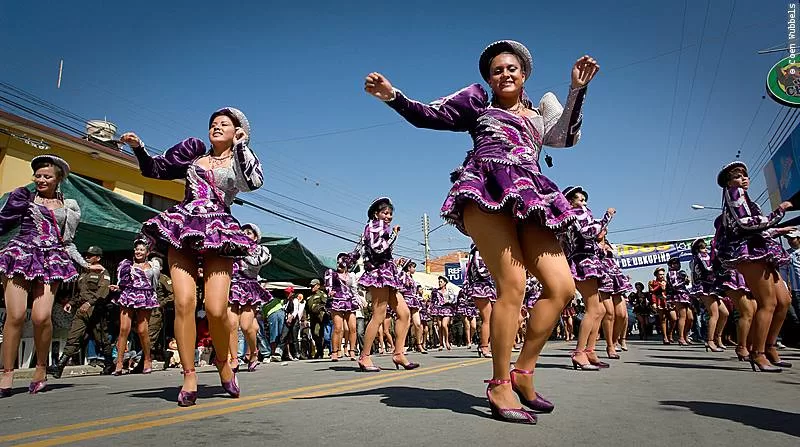
The energetic nature of Caporales is its defining characteristic. Dancers perform with incredible athleticism, featuring high jumps, powerful stomps, and quick turns, all executed with precision and synchronized movements. The Caporales dance meaning, while rooted in the historical figure of the overseer, has evolved to become a vibrant celebration of strength, pride, and youthful exuberance. The male Caporales costume is dazzling, featuring ornate, often sequined, shirts, wide-brimmed hats with feathers, and most notably, large bells (cascabeles) worn on the boots, which produce a distinct rhythmic sound with every powerful stomp. Female dancers wear short, brightly colored skirts, embroidered blouses, and often high-heeled boots, embodying grace and power. Caporales is a testament to the dynamic evolution of Bolivian folklore, showcasing how new traditions can emerge and thrive while still honoring historical influences. Its high-energy performances are a highlight of many Bolivian cultural events.
The Role of Music in Folklore Dances
Music is the soul of Bolivian folklore dances, an inseparable partner that dictates the pace, mood, and emotional depth of every performance. Without the vibrant and diverse musical influences, these dances would lose their essence. The rich soundscapes, often a fusion of indigenous Andean melodies and European harmonies, provide the heartbeat for Bolivia’s cultural heritage.
A wide array of instruments is used to create the distinctive sounds of Bolivian folklore. Indigenous instruments like the quena (Andean flute), siku or zampoña (panpipes), and charango (a small, ten-stringed lute) are central to many traditional tunes, offering haunting and evocative melodies. These are often combined with percussion instruments such as the bombo (large drum) and caja (snare drum), which provide the driving rhythms. With the advent of colonial influences, brass instruments like trumpets, trombones, and tubas became prominent, especially in larger ensembles for dances like the Morenada and Diablada. These brass bands, known as bandas, are a quintessential part of any major Bolivian festival, their powerful sound echoing through the streets.
The styles of music vary as widely as the dances themselves. Morenada music, for instance, is characterized by its heavy, plodding rhythm, often led by the deep brass and percussion, mirroring the dancers’ deliberate steps. Diablada music is grand and dramatic, with powerful fanfares and rhythmic shifts that accompany the theatrical battle between good and evil. Caporales music is fast-paced and upbeat, featuring a strong drum beat and catchy melodies that encourage energetic movement. Beyond these, there are countless other musical styles, from the melancholic huayño to the lively cueca, each deeply embedded in the fabric of Bolivian society and contributing to the rich tapestry of folklore music influences. The interplay between music and movement is symbiotic; the music inspires the dance, and the dance gives visual form to the music, creating a complete artistic expression that defines Bolivian cultural events.
Cultural Significance and Festivals
Bolivian folklore dances are not merely performances; they are profound expressions of cultural identity, historical memory, and spiritual devotion. Their cultural significance is deeply rooted in the country’s social fabric, serving as a powerful link between the past and the present. These dances are vital for preserving indigenous knowledge, historical narratives, and communal values, ensuring that Bolivia’s rich heritage continues to thrive.
The most spectacular showcase of these dances occurs during Bolivia’s numerous festivals, which are vibrant celebrations that bring entire communities to life. Among them, the Carnaval de Oruro stands as the undisputed highlight, a UNESCO-recognized masterpiece that draws hundreds of thousands of participants and spectators annually. This festival is an unparalleled demonstration of the Diablada, Morenada, Caporales, and dozens of other Bolivian dance styles. For days, the streets of Oruro transform into a massive stage where thousands of dancers, adorned in breathtaking traditional Bolivian costumes, parade for kilometers, performing intricate choreographies to the thunderous sound of brass bands. It’s a spiritual journey, a social gathering, and an artistic spectacle all rolled into one, embodying the very essence of Bolivian folklore. The festival’s religious origins, particularly its devotion to the Virgen del Socavón (Virgin of the Mines), blend seamlessly with pre-Columbian rituals, illustrating the unique syncretism that defines Bolivian culture.
Beyond Oruro, other important Bolivian festivals and cultural events provide platforms for these dance performances. The Gran Poder festival in La Paz is another magnificent display, celebrating the Aymara culture and the Señor del Gran Poder (Lord of Great Power). Here, thousands of dancers from various fraternities showcase a wide array of dances, often with even more opulent costumes than seen in Oruro, reflecting the economic prosperity of the participants. Smaller regional festivals, local patron saint celebrations, and even family gatherings across the country also feature these dances, ensuring that the tradition remains alive and accessible to all. These events are not just about entertainment; they are crucial moments for community cohesion, spiritual renewal, and the vibrant expression of Bolivia’s living cultural heritage. They provide a continuous thread that connects generations, reinforcing the pride and identity of the Bolivian people through the powerful medium of dance.
Costumes and Their Meanings
The traditional Bolivian costumes worn in folklore dances are integral to their storytelling and visual impact. Far from being mere garments, each costume is a work of art, meticulously crafted and laden with symbolism that reflects history, myth, social status, and spiritual beliefs. They are often incredibly heavy, intricate, and expensive, representing a significant investment of time, effort, and resources, and contributing immensely to the visual spectacle of dance performances in Bolivia.
Let’s look at some examples:
-
Morenada: As mentioned, the male Moreno costume is dominated by the enormous, often grotesque mask, typically made of plaster or fiberglass. These masks, with their bulging eyes and thick lips, are said to represent the suffering and exaggerated features of African slaves or, in some interpretations, the faces of their Spanish overseers. The wide-brimmed hats and heavy, embroidered capes (often weighing several kilograms) add to the impression of a burdened figure, emphasizing the dance’s historical narrative. The matracas (rattles) carried by dancers are not just noisemakers; their sound evokes the chains of slavery. Female Morenada costumes are equally distinctive, featuring multiple layers of polleras (skirts), a finely embroidered blouse, a shawl, and the iconic bombín (bowler hat), which has become a symbol of the cholita identity.
-
Diablada: The costumes of the Diablada are perhaps the most visually striking and symbolically rich. The devil masks are true masterpieces, crafted from papier-mâché, plaster, or fiberglass, adorned with elaborate horns, serpents, frogs, and other animals. These creatures are not random; they represent elements of both Andean cosmology (like the amaru or serpent, symbolizing the underworld) and Christian demonology. The colors also carry meaning: red for the devil, blue for the Virgin Mary, and so on. The full costume includes richly embroidered suits depicting biblical scenes or mythical figures, often adorned with sequins, mirrors, and precious stones that shimmer as the dancers move. The China Supay (female devil) costume often features a more seductive yet equally elaborate mask, short skirt, and high boots, reflecting a different aspect of temptation.
-
Caporales: The Caporales costumes, while newer, are no less significant. Male dancers wear brightly colored, often sequined, shirts, loose pants tucked into high boots, and ornate hats adorned with feathers and ribbons. The most distinctive feature for male dancers are the large, sonorous bells (cascabeles) attached to their boots, which create a powerful percussive rhythm with every stomp, emphasizing the dance’s energetic nature. Female Caporales dancers wear short, flowing skirts, decorated blouses, and often high-heeled boots, showcasing agility and grace. The overall aesthetic is one of vibrancy, strength, and modern flair, while still echoing the historical figure of the overseer in its military-inspired elements.
These traditional Bolivian costumes are not just worn; they are embodied. They transform the dancers, allowing them to step into roles that connect them to their ancestors, their history, and their spiritual beliefs. The intricate details, the vibrant colors, and the sheer artistry involved make these costumes a vital part of the folklore dance explanations and a powerful testament to Bolivia’s rich artistic tradition and cultural identity.
Learning Bolivian Folklore Dances
For those captivated by the energy, history, and beauty of Bolivian folklore dances, the good news is that there are many avenues available for learning these vibrant art forms. Whether you’re a seasoned dancer or a complete beginner, immersing yourself in these dance styles can be a deeply rewarding experience, offering a unique connection to Bolivia cultural heritage.
One of the best ways to learn is by seeking out dance academies and cultural centers specializing in Latin American dance. Many major cities in Bolivia, such as La Paz, Santa Cruz, and Cochabamba, have numerous schools that offer classes in popular dances like Morenada, Diablada, and Caporales. These institutions often have experienced instructors who are deeply knowledgeable about the history, technique, and cultural significance of each dance. They can guide you through the basic steps, teach you about the music, and even help you understand the nuances of the traditional Bolivian costumes.
Outside of Bolivia, particularly in countries with significant Bolivian diaspora communities (like the United States, Spain, Argentina, and Brazil), you can often find Bolivian cultural associations and fraternities. These groups are dedicated to preserving and promoting Bolivian folklore and frequently organize dance classes and workshops. Joining such a group not only provides an opportunity to learn the dances but also to connect with the wider Bolivian community and participate in their local cultural events and dance performances in Bolivia (or abroad). Many fraternities prepare year-round for major festivals like Carnaval de Oruro or Gran Poder, offering an authentic and immersive learning experience.
For those who prefer a more self-guided approach, online resources can be a great starting point. YouTube is a treasure trove of tutorials, performance videos, and documentaries that can help you grasp the basic movements and rhythms. Look for channels dedicated to Bolivian folklore or specific dance styles. However, remember that while online videos can teach you steps, they can’t fully convey the cultural context and the communal spirit that is so vital to these dances.
Tips for aspiring dancers:
-
Start with the basics: Don’t try to master the most complex choreography right away. Focus on fundamental steps and rhythms. Caporales, with its energetic yet repetitive movements, can be a good entry point for beginners.
-
Listen to the music: Immerse yourself in folklore music influences. Understanding the rhythm and instrumentation will naturally guide your movements.
-
Learn the history: Knowing the cultural significance of dances and the stories behind them will deepen your appreciation and improve your performance.
-
Embrace the community: These dances are inherently communal. Participating in a group or finding a dance partner will enhance your learning experience and introduce you to the social aspects of Bolivian folklore.
-
Be patient and persistent: Like any art form, learning to dance takes time and practice. Enjoy the journey and the process of connecting with Bolivia’s rich cultural heritage.
Learning Bolivian folklore dances is more than just acquiring a new skill; it’s an invitation to experience Bolivia’s vibrant soul, connect with its people, and become part of a living tradition that celebrates history, art, and society.
Conclusion
The vibrant world of Bolivian folklore dances is a powerful testament to the nation’s profound cultural identity and rich history. As we’ve explored the intricate steps of the Morenada, the dramatic symbolism of the Diablada, and the energetic flair of the Caporales, it becomes clear that these are more than just performances; they are living narratives. Each dance, each costume, and every note of music serves as a vital thread in the elaborate tapestry of Bolivian heritage, weaving together indigenous traditions, colonial influences, and the enduring spirit of its people.
These traditional Bolivian dance styles are crucial for preserving the country’s collective memory, transmitting values across generations, and reinforcing the strong sense of community that defines Bolivian society. From the awe-inspiring spectacle of the Carnaval de Oruro to countless local celebrations, these dances are the heart of Bolivian festivals, demonstrating an unwavering commitment to cultural expression. The elaborate traditional Bolivian costumes, rich with symbolism, and the diverse folklore music influences, from ancient panpipes to booming brass bands, all contribute to an experience that is deeply engaging and uniquely Bolivian.
In a rapidly changing world, the continued practice and celebration of Bolivian folklore dances ensure that the stories, struggles, and triumphs of the past remain alive and relevant. They are a dynamic art form, constantly evolving yet always rooted in the soil of tradition. For enthusiasts and learners alike, exploring these dances offers a profound connection to Bolivia’s soul, a celebration of its resilience, creativity, and the vibrant spirit that pulsates through every step, making them an indispensable part of Latin American dance and a cherished global cultural heritage.
Logging in to 68jllogin is a breeze! Quick and easy access to my account. No complaints here! Register and login at 68jllogin.
sss777 https://www.websss777.org
pokebet88 https://www.solpokebet88.com