
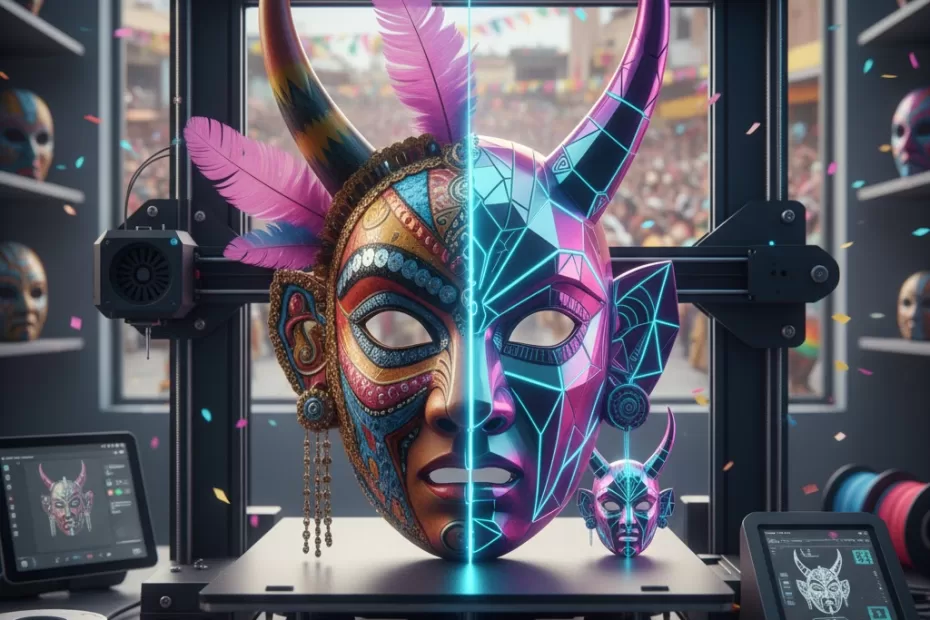
The Intersection of 3D Printing and Oruro Carnival Masks
Imagine a world where ancient traditions meet cutting-edge technology, where the vibrant cultural heritage of Bolivia is enhanced by the precision and innovation of modern manufacturing. This is precisely the fascinating intersection we explore when looking at 3D printing and Oruro Carnival masks. The Oruro Carnival, a UNESCO Intangible Cultural Heritage of Humanity, is a dazzling spectacle of dance, music, and intricate costumes, with its masks being central to its storytelling and artistic expression. For centuries, these carnival masks have been meticulously crafted by skilled artisans, embodying the myths, legends, and spiritual beliefs of the Andean people. Now, a new chapter is unfolding as 3D printing technology begins to influence and transform these traditional crafts, offering new possibilities for design, customization, and production. This unique fusion of art and technology not only preserves the essence of Bolivian culture but also propels it into the future, inviting both seasoned mask artists and DIY enthusiasts to explore innovative art forms.
Introduction to Oruro Carnival Masks
The Oruro Carnival, held annually in Oruro, Bolivia, is more than just a festival; it’s a profound manifestation of cultural identity and spiritual devotion. Recognized by UNESCO in 2001, it is one of the largest and most significant cultural events in South America, drawing hundreds of thousands of participants and spectators each year. At its core, the carnival is a syncretic celebration, blending indigenous Andean beliefs with Catholic traditions, primarily honoring the Virgen del Socavón (Virgin of the Mines).
The festivities are a vibrant tapestry of music, dance, and elaborate costumes, culminating in a grand procession known as the “entrada.” During this procession, thousands of dancers, organized into various folkloric groups, perform intricate choreographies through the city’s streets for days. Each dance group represents a specific tradition, myth, or historical event, and their attire, particularly their masks, plays a crucial role in conveying these narratives.
Masks are undoubtedly the soul of the Oruro Carnival. They are not merely decorative accessories but powerful symbols, imbued with deep cultural significance. These festive masks transform the dancers, allowing them to embody mythological creatures, historical figures, or allegorical representations. For instance, the Diablada, or “Dance of the Devils,” is perhaps the most iconic dance, featuring dancers adorned in terrifying yet magnificent devil masks. These masks, often depicting horned devils with bulging eyes, fangs, and serpents, symbolize the struggle between good and evil, a central theme of the carnival. Other popular dances, such as the Morenada, feature masks of enslaved African miners, reflecting the region’s colonial history, while the Tobas wear masks inspired by Amazonian tribes.
The traditional mask making techniques for these elaborate pieces often involve materials like plaster, papier-mâché, clay, and metal, meticulously shaped, painted, and adorned with details like glass eyes, animal horns, and intricate ornamentation. Each mask is a work of art, often taking weeks or even months to complete, and is crafted with immense skill and reverence. The masks are believed to protect the wearer, ward off evil spirits, and connect them to the spiritual realm, making them indispensable to the carnival traditions and Bolivian culture. Their creation is a testament to the enduring artistic expression and dedication of generations of mask artists, whose craftsmanship ensures the continuity of these vital cultural crafts.
What is 3D Printing?
At its heart, 3D printing, also known as additive manufacturing, is a revolutionary process of creating three-dimensional objects from a digital design. Unlike traditional subtractive manufacturing methods, where material is removed from a larger block, 3D printing builds an object layer by successive layer until the physical object is complete. This innovative art form has moved from industrial applications to accessible tools for creative projects and beyond.
The process typically begins with a 3D model created using Computer-Aided Design (CAD) software. This digital design is then sliced into hundreds or thousands of thin horizontal layers by specialized software. This “sliced” file, often in a format like STL, is then fed into a 3D printer. The printer then precisely deposits or solidifies material, layer by layer, according to the digital instructions.
There are several types of 3D printing technology, each suited for different materials and applications:
-
Fused Deposition Modeling (FDM): This is the most common and affordable type, used by many hobbyists and for DIY mask projects. It works by extruding a thermoplastic filament (like PLA or ABS) through a heated nozzle, depositing it onto a build plate in layers.
-
Stereolithography (SLA): SLA printers use a UV laser to cure liquid resin layer by layer, creating highly detailed and smooth objects. This method is often preferred for intricate designs requiring high precision.
-
Selective Laser Sintering (SLS): SLS printers use a laser to fuse powdered material (like nylon) together, layer by layer. This results in strong, functional parts without the need for support structures.
-
Digital Light Processing (DLP): Similar to SLA, but uses a digital light projector to flash an entire layer at once, making it faster for certain applications.
The applications of 3D printing are vast and ever-expanding. In the medical field, it’s used to create custom prosthetics, surgical guides, and even bioprint organs. Aerospace and automotive industries leverage it for prototyping, lightweight parts, and complex geometries. Architecture uses it for scale models, while fashion designers create unique garments and accessories. For artists and designers, 3D printing applications open up new avenues for artistic expression, enabling the creation of intricate sculptures, custom jewelry, and, as we’re exploring, highly detailed carnival masks. This technology in art provides unparalleled freedom in mask design, allowing for complex geometries that would be challenging or impossible with traditional crafting traditions.
The Evolution of Mask Making: From Tradition to Technology
The art of mask making is a timeless human endeavor, deeply rooted in cultural and spiritual practices worldwide. In Bolivia, particularly for the Oruro Carnival, mask making techniques have been passed down through generations, relying on skilled hands, traditional materials, and time-honored methods. The introduction of 3D printing technology marks a significant evolutionary step, offering both challenges and exciting opportunities for this ancient craft.
Historically, Oruro Carnival mask production has been a labor-intensive process. Artisans begin by sculpting a model, often from clay, which is then used to create a mold. Materials like papier-mâché, plaster-soaked cloth, or sheet metal are pressed into these molds, painstakingly shaped, dried, and then reinforced. The masks are then adorned with vibrant paints, intricate details, glass eyes, real animal horns, and other embellishments. This process demands immense patience, artistic skill, and a deep understanding of the cultural narratives embedded in each design. The unique textures, imperfections, and hand-finished qualities are part of their charm, reflecting the human touch and the spirit of craftsmanship that defines Bolivian culture.
However, traditional methods also come with limitations. Replicating complex designs precisely can be challenging, consistency across multiple masks might vary, and the time required for production can be extensive, especially for large-scale carnival celebrations. This is where the dialogue between tradition and technology becomes particularly interesting, as modern tools begin to complement, rather than replace, established practices.
Historical Significance of Masks in Oruro Carnival
To truly appreciate the impact of 3D printing, one must first grasp the profound historical significance of masks in the Oruro Carnival. These aren’t merely costumes; they are powerful conduits of history, mythology, and social commentary. The use of masks in the Andes predates the Spanish conquest, with indigenous cultures employing them in rituals and ceremonies to connect with ancestral spirits, agricultural deities, and the forces of nature. When the Spanish arrived, they introduced Catholic traditions, leading to the syncretism that defines the Oruro festival today.
The devil masks, central to the Diablada, are a prime example. While ostensibly representing Christian devils, their origins are often traced back to Andean deities like Supay, the lord of the Ukhu Pacha (underworld), who was not purely evil but a complex figure associated with both darkness and fertility. The elaborate serpent motifs, fangs, and grotesque features on these masks reflect a fusion of pre-Columbian iconography with European demonic imagery. Each element, from the color choices to the specific animal features, carries symbolic weight, telling a story of cosmic battles, colonial encounters, and the enduring resilience of indigenous beliefs.
Beyond the Diablada, masks in other dances like the Morenada (which often feature exaggerated features, pale skin, and sometimes chains, representing the suffering and eventual defiance of African slaves brought to the mines) or the Kullawada (with its distinct hat-mask combinations) serve as visual encyclopedias of Bolivia cultural heritage. They are living artifacts that bridge generations, ensuring that the stories, struggles, and triumphs of the past are remembered and re-enacted annually. The act of wearing these carnival masks is a transformative experience, allowing participants to step into the shoes of their ancestors, embody spiritual beings, and participate in a collective affirmation of their identity. The mask manufacturing process, therefore, is not just about creating an object; it’s about preserving and transmitting cultural memory.
Benefits of Using 3D Printing for Mask Production
The integration of 3D printing technology into the creation of Oruro Carnival masks offers several compelling advantages, particularly for artists looking to innovate while respecting tradition.
-
Precision and Detail: One of the most significant benefits is the unparalleled precision offered by 3D printing. Complex geometries, intricate patterns, and fine details that would be incredibly challenging or time-consuming to sculpt by hand can be rendered with exact accuracy. This allows for new levels of artistic expression and the creation of highly elaborate mask designs that push the boundaries of traditional aesthetics. Whether it’s the scales of a serpent on a devil mask or the delicate filigree on a traditional careta, 3D printing can achieve consistent, high-fidelity results.
-
Customization and Personalization: 3D printing excels at producing custom mask design. Artists can easily modify digital models to create masks perfectly tailored to an individual’s face, ensuring a comfortable and secure fit. Furthermore, variations in design can be implemented swiftly, allowing for personalized artistic touches or adaptations for different dancers within a group. This flexibility is a game-changer for mask artists who often deal with diverse requests and body types. This ability to create unique, custom pieces elevates the craft, allowing for greater creative projects.
-
Speed and Efficiency: While traditional mask making is a slow, methodical art, 3D printing can significantly reduce production time for certain stages. Once a 3D model is finalized, printing can occur relatively quickly, especially for multiple identical or similar components. This can be particularly beneficial for groups needing many masks or components for their carnival celebrations, streamlining the mask manufacturing process and allowing more time for finishing and embellishment.
-
Prototyping and Iteration: 3D printing technology makes it incredibly easy to prototype new mask designs. Artists can print multiple iterations of a design, test different shapes, sizes, and features without investing heavily in materials or labor for each version. This iterative design process allows for experimentation and refinement, leading to better final products. A DIY mask maker can experiment with different horn shapes or facial expressions before committing to a final print.
-
New Material Possibilities: While traditional masks use specific materials, 3D printing opens the door to using various plastics, resins, and even flexible filaments. These materials can offer different properties in terms of weight, durability, and texture, potentially leading to lighter, more comfortable, or more robust carnival masks. For example, lightweight plastic masks can be easier for dancers to wear for extended periods during the Oruro festival.
-
Accessibility for New Artists: With accessible 3D design software and affordable desktop printers, aspiring mask artists and enthusiasts can now engage in mask making without needing years of apprenticeship in traditional sculpting and molding. This democratizes the craft, inviting a new generation interested in art and technology to contribute to Bolivian cultural heritage.
While 3D printing offers these advantages, it’s crucial to note that it’s often used as a tool to complement, rather than entirely replace, traditional craftsmanship. The hand-painting, embellishment, and final touches still require the skill and artistic eye of human artisans, ensuring that the soul of the Oruro Carnival mask remains intact.
Case Studies: Artists Merging 3D Printing with Oruro Masks
The integration of 3D printing into the traditional world of Oruro Carnival masks is still an emerging field, but it’s one filled with immense potential and exciting early examples. While specific, widely publicized large-scale projects directly merging 3D printing with the entire Oruro Carnival mask production might still be developing, individual artists and smaller groups are certainly experimenting, pushing the boundaries of what’s possible. These creative projects often showcase how technology in art can breathe new life into cultural crafts.
One notable example of this innovative art approach comes from designers and artisans who work with folkloric dance groups. Faced with the challenge of producing multiple, consistent, and intricate masks for large ensembles, some have turned to 3D modeling and printing for specific components or even entire base structures. For instance, a designer might 3D print the intricate horns of a Diablada mask, ensuring perfect symmetry and detail across all masks, then hand-finish the rest of the piece using traditional materials like papier-mâché and paint. This hybrid approach combines the strengths of both worlds: the precision and replicability of 3D printing for complex structural elements, and the artistic touch and traditional aesthetic for the final embellishments.
Another area where 3D printing is making inroads is in the creation of lighter, more comfortable masks. Traditional masks, especially the elaborate devil masks, can be quite heavy, posing a challenge for dancers who perform for hours. Artists are experimenting with 3D printing lightweight plastic bases that can then be decorated with traditional materials. This reduces the overall weight without sacrificing the visual impact or cultural significance of the mask. The 3D printed masks serve as a strong, light foundation, over which layers of fabric, paint, and adornments are applied, making the festive masks more wearable.
Furthermore, academic institutions and cultural preservation groups are exploring 3D scanning and printing to create digital archives of historical Oruro traditions and carnival masks. By scanning existing antique masks, they can create precise digital replicas, which can then be 3D printed for display, study, or even as molds for traditional production. This not only aids in the documentation and preservation of Bolivian cultural heritage but also allows for a new way to share these artistic expressions with a global audience. While these might not be directly part of the carnival performance, they demonstrate the broader impact of 3D printing applications in safeguarding and promoting cultural artifacts.
The beauty of these case studies lies in their collaborative nature. It’s not about replacing the master artisan but empowering them with new tools. A traditional mask artist might partner with a 3D designer to bring their intricate visions to life, using 3D modeling to refine a design before printing a prototype or a component. This collaboration fosters a vibrant environment where traditional knowledge and modern innovation coexist and mutually enrich each other, ensuring the evolution of carnival arts.
Innovative Designs and Techniques
The fusion of 3D printing and Oruro Carnival masks naturally leads to innovative designs and techniques that might have been impossible or impractical with traditional methods alone.
One significant area of innovation is in the complexity of form and detail. 3D design software allows artists to create geometries that are incredibly intricate, featuring fine textures, interlocking patterns, or delicate filigrees that would be exceedingly difficult to sculpt by hand. Imagine a Diablada mask where each scale of the serpent is individually sculpted in the digital realm and then flawlessly replicated by a 3D printer. This level of detail enhances the visual storytelling of the masks, making them even more captivating.
Modular mask design is another exciting technique. Instead of creating a single, monolithic mask, artists can design and 3D print individual components – horns, teeth, eyes, or decorative elements – that can then be assembled and attached to a traditional base. This approach offers several advantages: it allows for easier replacement of damaged parts, enables greater customization (e.g., swapping out different horn designs), and can streamline the production process by allowing different elements to be printed simultaneously. This modularity also facilitates collaborative efforts, where specialists can focus on different parts of the mask.
Artists are also exploring parametric design, where a single 3D model can be easily modified to produce a family of variations. For example, a base devil mask design could be parametrically adjusted to create masks of different sizes, with varying horn lengths, or slightly altered facial expressions, all from the same core digital file. This is incredibly useful for dance groups that need a cohesive look with subtle individual variations for their carnival traditions.
Furthermore, the ability to use different 3D printing materials opens up new aesthetic and functional possibilities. While traditional masks rely on plaster, papier-mâché, or metal, 3D printing offers access to various plastics, flexible filaments, and even composite materials. Artists can experiment with transparent or translucent plastics for illuminated mask elements, or flexible filaments for parts that need to bend or withstand impact. This expands the material palette for mask artists, allowing for more dynamic and durable carnival masks.
The rise of digital sculpting tools, which mimic traditional sculpting but in a virtual environment, allows artists to maintain a tactile, organic feel in their designs before sending them to a 3D printer. This bridges the gap between the hand-crafted aesthetic and digital precision, ensuring that the spirit of the traditional crafts is not lost in the technological translation. These innovative art forms are not just about making things faster or cheaper, but about expanding the creative horizons for artistic expression within Bolivian culture.
DIY Guide: Creating Your Own Oruro Carnival Mask with 3D Printing
Embarking on a DIY mask project using 3D printing is a fantastic way to blend your passion for technology with an appreciation for cultural heritage. While creating a full-fledged, traditional Oruro Carnival mask requires years of mastery, 3D printing allows you to craft a unique, personalized version that honors the spirit of the Oruro festival. This guide will walk you through the process of designing and printing your own custom mask design, bringing the magic of 3D printed masks to your creative projects.
Before you dive in, remember that the Oruro Carnival masks are deeply symbolic. While your DIY mask can be a creative interpretation, understanding the cultural significance of the traditional designs – whether it’s the fierce Diablada devil or the expressive Morenada – will enrich your project.
Materials and Tools Needed
To get started on your 3D printed Oruro Carnival mask, you’ll need a few essential items:
-
3D Printer: An FDM printer is generally the most accessible and affordable option for beginners. Brands like Creality, Prusa, or Ender are popular choices. Ensure your printer has a build volume large enough for your mask or that you plan to print it in sections.
-
Filament: PLA (Polylactic Acid) is recommended for beginners due to its ease of printing, low odor, and biodegradability. Choose colors that will serve as a good base for painting, or go bold with a vibrant hue. ABS or PETG are stronger but harder to print.
-
3D Design Software:
-
Beginner-Friendly: Tinkercad (web-based, very easy to learn for basic shapes).
-
Intermediate: Fusion 360 (free for hobbyists, powerful parametric design), Blender (free, open-source, excellent for organic sculpting, but has a steeper learning curve).
-
Advanced: ZBrush (industry standard for digital sculpting, best for highly organic and detailed masks).
-
-
Slicing Software: Most 3D printers come with or recommend specific slicing software (e.g., Cura, PrusaSlicer, Simplify3D). This software converts your 3D model into instructions for the printer.
-
Post-Processing Tools:
-
Sandpaper: Various grits (120, 220, 400, 600) for smoothing rough surfaces.
-
Primer: Sandable filler primer (spray paint) to prepare the surface for painting.
-
Paints: Acrylic paints are versatile and easy to work with. Consider metallic paints for accents.
-
Brushes: Assorted sizes for detail work and broader strokes.
-
Clear Coat/Sealant: To protect your painted mask.
-
Adhesives: Super glue or epoxy for assembling printed parts.
-
Elastic Strap/Ribbon: For wearing the mask.
-
Optional Embellishments: Feathers, glitter, sequins, faux gems, fabric, or even small 3D printed additions for extra flair, echoing traditional Oruro festive masks.
-
-
Safety Gear: Respirator mask (for sanding and painting), safety glasses.
Step-by-Step Instructions
Step 1: Design Your Mask
-
Inspiration and Research: Start by researching Oruro Carnival masks. Look at images of Diablada, Morenada, Tobas, and other traditional styles. Identify elements you love – horn shapes, facial expressions, symbolic motifs. Don’t copy directly, but draw inspiration from the rich Bolivian culture.
-
Sketching: Hand-sketch your ideas. This helps you visualize the mask’s overall shape, features, and how it will sit on a face.
-
3D Modeling:
-
Basic Shape: Begin with a generic face base model (many are available online for free or purchase, or you can sculpt one from scratch). Import this into your chosen 3D design software.
-
Customization: Sculpt or add features inspired by Oruro masks. Think about exaggerated brows, prominent noses, fangs, horns, or decorative swirls. Use reference images to guide your artistic expression.
-
Fit: Ensure the mask is appropriately sized for an adult face. You might want to measure your own face or use average dimensions. Consider eye holes, nose clearance, and mouth opening if desired.
-
Details: Add intricate details like scales, textures, or symbolic patterns. Remember the precision 3D printing offers.
-
Thickness: Ensure the mask walls are thick enough to be durable (typically 2-3mm is a good starting point).
-
Ventilation/Attachment Points: Incorporate small holes on the sides for attaching an elastic strap or ribbon. Add small loops or tabs on the inside if you plan to attach other embellishments later.
-
Splitting (if necessary): If your mask is too large for your printer’s build volume, design it in printable sections with interlocking joints or flat surfaces for easy gluing.
-
Step 2: Prepare for 3D Printing (Slicing)
-
Export Your Model: Once your 3D model is complete, export it as an STL file (or OBJ).
-
Import to Slicer: Open your slicing software and import the STL file.
-
Positioning: Orient the mask on the virtual print bed for optimal printing. Generally, printing with the back of the mask flat on the bed, or slightly angled, can reduce support material and improve surface finish.
-
Settings:
-
Layer Height: For detailed masks, a lower layer height (e.g., 0.12mm – 0.2mm) will give smoother results, but take longer. A higher layer height (e.g., 0.28mm) is faster but shows more layer lines.
-
Infill: 10-20% infill is usually sufficient for masks, balancing strength and weight.
-
Supports: Most masks will require support structures, especially for overhangs like noses, chins, or horns. Experiment with tree supports if available, as they can be easier to remove.
-
Brim/Raft: Use a brim for better bed adhesion, especially for masks with a small footprint.
-
Print Speed: A moderate speed (e.g., 50-60mm/s) is a good balance of speed and quality.
-
-
Slice and Save: Slice the model. Review the preview to ensure supports look correct and the print path is optimized. Save the G-code file to your printer’s SD card or send it over Wi-Fi.
Step 3: 3D Print Your Mask
-
Prepare Printer: Load your chosen filament. Ensure the print bed is clean and properly leveled.
-
Start Print: Insert the SD card (or connect via USB/Wi-Fi) and start the print.
-
Monitor: Keep an eye on the first few layers to ensure good bed adhesion and no major errors. 3D printing technology requires some monitoring, especially for larger prints.
-
Patience: Large masks can take many hours to print, sometimes even days depending on size and detail.
Step 4: Post-Processing and Finishing
-
Remove from Bed: Carefully remove the printed mask from the build plate.
-
Remove Supports: Gently peel or cut away all support structures. Use flush cutters or a hobby knife for precision.
-
Assembly (if printed in parts): If your mask was printed in sections, use super glue or epoxy to carefully join the pieces. Ensure a strong bond and proper alignment. Clamp or tape parts together while drying.
-
Sanding: This is crucial for a smooth finish. Start with a coarser grit sandpaper (120-220) to remove prominent layer lines and imperfections. Gradually move to finer grits (400-600) for a smoother surface. Wet sanding can also help. Wear a respirator.
-
Priming: Apply several thin, even coats of sandable filler primer. This fills in any remaining small layer lines and provides a uniform surface for painting. Sand lightly between coats with fine-grit sandpaper (600+).
-
Painting:
-
Base Coat: Apply a base color to your entire mask.
-
Details: Use smaller brushes for intricate details, patterns, and features. Reference Oruro Carnival mask images for color palettes and traditional motifs. Embrace the vibrant carnival arts.
-
Shading/Highlights: Add depth with shading and highlights.
-
Eyes: Paint eyes last, making sure they are expressive and impactful.
-
-
Embellishments: Once the paint is dry, add any optional embellishments like feathers, glitter, sequins, or faux gems. These can dramatically enhance the festive masks.
-
Clear Coat: Apply a clear protective sealant (matte, satin, or gloss, depending on your preference) to protect the paint and give a professional finish.
-
Attach Strap: Thread an elastic strap or ribbon through the holes you designed on the sides of the mask. Adjust for a comfortable fit.
Congratulations! You’ve just created your own 3D printed Oruro Carnival mask, a testament to the blend of traditional crafts and modern 3D printing applications, a true creative project for any DIY mask enthusiast.
The Future of Mask Making in Cultural Celebrations
As technology continues its relentless march forward, its influence on traditional cultural celebrations like the Oruro Carnival is bound to grow. The intersection of 3D printing and Oruro Carnival masks is just one exciting example of how modern tools can both preserve and revolutionize ancient artistic expressions. The future of mask making in cultural celebrations holds immense promise, offering new avenues for creativity, accessibility, and cultural exchange.
One significant trend will likely be the democratization of mask making. As 3D printing technology becomes even more affordable and user-friendly, individuals and small communities, regardless of their access to traditional workshops or master artisans, will be able to design and produce custom mask designs. This could lead to an explosion of creative projects and a wider diversity of artistic expression within established carnival traditions. Aspiring mask artists and cultural enthusiasts globally could create their own interpretations, fostering a deeper connection to festivals like Oruro, even from afar.
We can anticipate a rise in hybrid craftsmanship, where the lines between traditional and digital methods blur. Instead of 3D printing replacing handcrafting entirely, it will likely serve as a powerful complement. Artisans might use 3D printing for prototyping complex shapes, creating custom molds, or producing intricate components like horns, teeth, or decorative appliques, which are then integrated into traditionally made masks. This approach allows for the preservation of the handmade aesthetic and the cultural significance of traditional materials, while leveraging the efficiency and precision of technology. The unique blend of hand-painted details on a structurally perfect 3D printed base could become a new signature style in carnival arts.
Material innovation will also play a crucial role. Advances in 3D printing materials could lead to masks that are even lighter, more durable, more flexible, or even incorporate smart features like embedded lights or sensors. Imagine masks with dynamically changing LED patterns or interactive elements that respond to music or movement, adding new layers to the festive masks and carnival celebrations. These innovations could enhance the visual spectacle and the immersive experience for both performers and audiences, while still honoring the essence of Bolivian culture.
Furthermore, digital archives and virtual experiences will become increasingly important for cultural preservation. 3D scanning technology can capture existing, historical Oruro Carnival masks with incredible detail, creating digital libraries that safeguard these artifacts against loss or decay. These digital models can then be used for educational purposes, virtual reality experiences, or even as templates for future mask production. This ensures that the rich cultural heritage and crafting traditions of Oruro remain accessible and understood by future generations, both locally and globally, fostering a deeper appreciation for festivals around the world.
Finally, the dialogue between art and technology will continue to inspire innovative art forms. Artists will push the boundaries of mask design, exploring abstract forms, biomechanical aesthetics, or incorporating elements from other cultures, all while drawing inspiration from the deep well of Oruro traditions. This evolution is not about losing tradition but about finding new ways to express it, ensuring that the Oruro Carnival and its magnificent masks continue to captivate and inspire for centuries to come, embodying a dynamic fusion of past, present, and future in the realm of artistic expression.
Conclusion
The journey through the world of 3D printing and Oruro Carnival masks reveals a compelling narrative of tradition meeting innovation. The Oruro Carnival, with its profound cultural significance and breathtaking array of festive masks, stands as a testament to Bolivia cultural heritage and the enduring power of artistic expression. For centuries, skilled mask artists have meticulously crafted these symbolic pieces, embedding within them the myths, history, and spiritual devotion of the Andean people.
Now, with the advent of 3D printing technology, a new chapter is unfolding. This modern additive manufacturing process, with its unparalleled precision, customization capabilities, and efficiency, is not seeking to replace the revered traditional crafts but rather to enrich them. From enabling the creation of intricate, lightweight structures to facilitating rapid prototyping and opening up new material possibilities, 3D printing offers a powerful toolkit for mask makers. It empowers both seasoned artisans and DIY mask enthusiasts to explore innovative art forms, pushing the boundaries of what’s possible in mask design while respecting the deep-rooted carnival traditions.
The benefits are clear: greater detail, personalized fit, streamlined production for specific components, and a broader scope for creative projects. While the human touch in painting, embellishing, and infusing cultural meaning remains paramount, the collaboration between traditional mask making techniques and 3D printing applications demonstrates how technology in art can serve as a bridge between the past and the future.
As we look ahead, the future of mask making in cultural celebrations promises even greater synergy. We can anticipate more hybrid creations, increased accessibility for new generations of artists, and material innovations that will further enhance the visual and experiential impact of carnival masks. This unique fusion of 3D printing and Oruro Carnival masks is more than just a technological advancement; it’s a vibrant testament to the adaptability of culture, ensuring that the dazzling artistry and profound stories of Oruro continue to be told, celebrated, and evolved for generations to come, truly embodying the spirit of festivals around the world.
Hey! Gave vn88io a go recently. It has a decent interface, and the deposit methods are pretty convenient. Worth a shot if you’re looking for a new spot. Check it out here: vn88io